Graph Theory
Graphs are used to show how things are connected. They can be used to help solve problems in train scheduling, traffic flow, bed usage in hospitals, and project management.
The theory of graphs was developed centuries ago, but the application of the theoretical ideas is relatively recent. Real progress was made during and after the Second World War as mathematicians, industrial technicians, and members of the armed services worked together to improve military operations.
The theory of graphs was developed centuries ago, but the application of the theoretical ideas is relatively recent. Real progress was made during and after the Second World War as mathematicians, industrial technicians, and members of the armed services worked together to improve military operations.
Definitions
Definition Graph
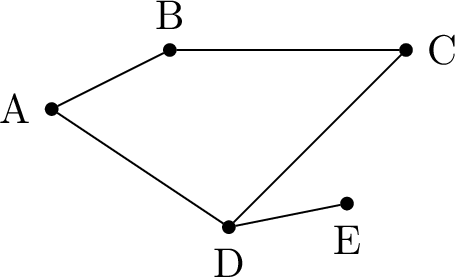
A graph (or network) is a structure which shows the physical connections or relationships between things of interest.
The things of interest are represented by vertices (singular: vertex), also called nodes or points.
The connections or relationships are represented by edges, also called lines or arcs.
The things of interest are represented by vertices (singular: vertex), also called nodes or points.
The connections or relationships are represented by edges, also called lines or arcs.
Example
Definition Degree of a Vertex
The degree of a vertex, denoted \(\deg(v)\), is the number of edges connected to it.
If a loop exists (an edge connecting a vertex to itself), it contributes 2 to the degree of that vertex.
If a loop exists (an edge connecting a vertex to itself), it contributes 2 to the degree of that vertex.
Example
Definition Undirected Graph
In an undirected graph, movement is allowed in either direction along the edges. The relationship is symmetric.
- Adjacent vertices are vertices connected by an edge.
- Adjacent edges are edges which share a common vertex.
Example
Definition Directed Graph
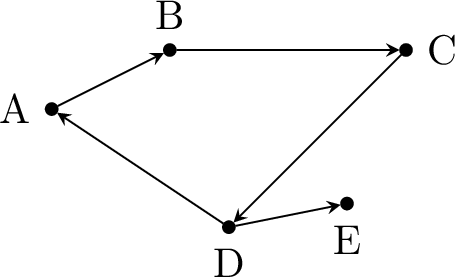
A directed graph (or digraph) contains arrows indicating the direction we can move along the edges.
- The in-degree is the number of edges coming into the vertex.
- The out-degree is the number of edges going out from the vertex.
Example
Definition Weighted Graph
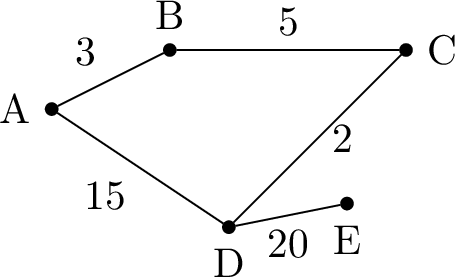
A weighted graph has numbers assigned to its edges. These numbers may represent the cost, time, or distance.
Example
Definition Walk\(\virgule\) Trail\(\virgule\) Path\(\virgule\) circuit and Cycle
- A walk is a sequence of vertices such that each successive pair is adjacent.
- A trail is a walk in which no edge is repeated.
- A path is a walk in which no vertex is repeated.
- A circuit is a walk in which no edge is repeated that starts and ends at the same vertex.
- A cycle is a walk in which no vertex is repeated except the first/last vertex that starts and ends at the same vertex.
Example
- \(A\rightarrow B\rightarrow C\) is a walk because there is an edge between \(A\) and \(B\) and an edge between \(B\) and \(C\).
- \(A\rightarrow B\rightarrow A\) is not a trail because the edge between \(A\) and \(B\) is repeated.
- \(A\rightarrow B\rightarrow C\rightarrow D\rightarrow A\) is not a path because the vertex \(A\) is repeated.
- \(A\rightarrow B\rightarrow C\rightarrow D\rightarrow A\) is a circuit (and a cycle).
Properties of Graphs
Definition Connected Graph
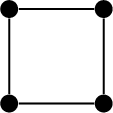
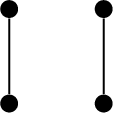
A graph is called connected if it is possible to travel from any vertex to any other vertex via a sequence of edges.
Example
| Connected | Disconnected |
 |  |
Definition Complete Graph
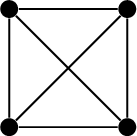
A complete graph is a simple undirected graph in which every vertex is connected by an edge to every other vertex.
The notation \(K_n\) is used to describe the complete graph with \(n\) vertices.
The notation \(K_n\) is used to describe the complete graph with \(n\) vertices.
Example
Adjacency Matrices
Definition Adjacency Matrix
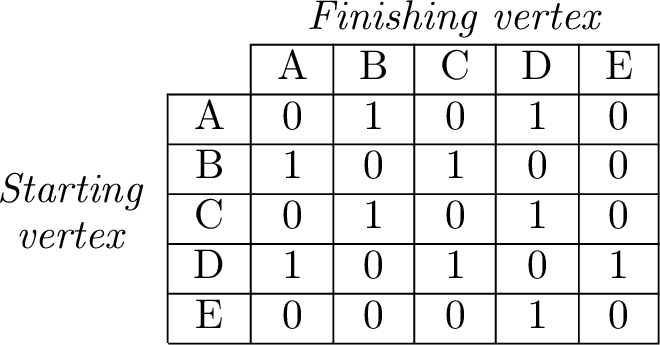
For a graph with \(n\) vertices, the adjacency matrix \(\mathbf{M}\) is an \(n \times n\) matrix where the element \(m_{ij}\) represents the number of direct edges from vertex \(i\) to vertex \(j\).
Example
Proposition Multi-step Walks
If \(\mathbf{M}\) is the adjacency matrix, then the element \((i,j)\) of \(\mathbf{M}^k\) gives the number of walks of length \(k\) from vertex \(i\) to vertex \(j\).
Example
To understand why the powers of \(\mathbf{M}\) give the multi-step adjacency matrices, consider the 2-step matrix: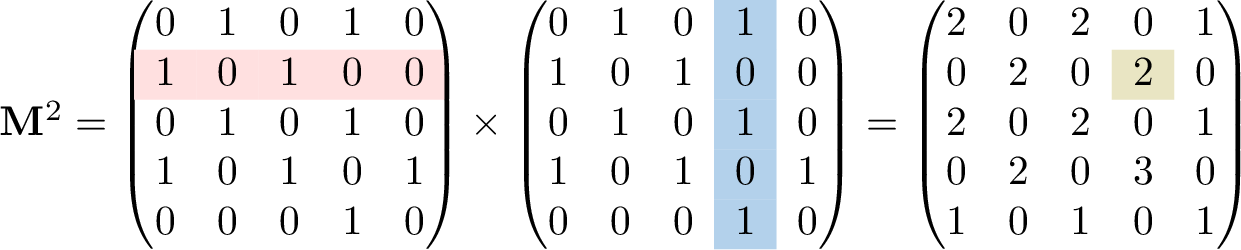
This value comes from the multiplication row 2 \(\times\) column 4 as follows:
This value comes from the multiplication row 2 \(\times\) column 4 as follows:
- \(1 \times 1 = 1\) walk from B to A \(\times\) 1 walk from A to D
- \(0 \times 0 = 0\) walks from B to B \(\times\) 0 walks from B to D
- \(1 \times 1 = 1\) walk from B to C \(\times\) 1 walk from C to D
- \(0 \times 0 = 0\) walks from B to D \(\times\) 0 walks from D to D
- \(0 \times 1 = 0\) walks from B to E \(\times\) 1 walk from E to D