\( \definecolor{colordef}{RGB}{249,49,84} \definecolor{colorprop}{RGB}{18,102,241} \)

Times Tables

A Tool for Fast Multiplication


There are 5 empty boxes, and each box needs 9 pencils to be full.
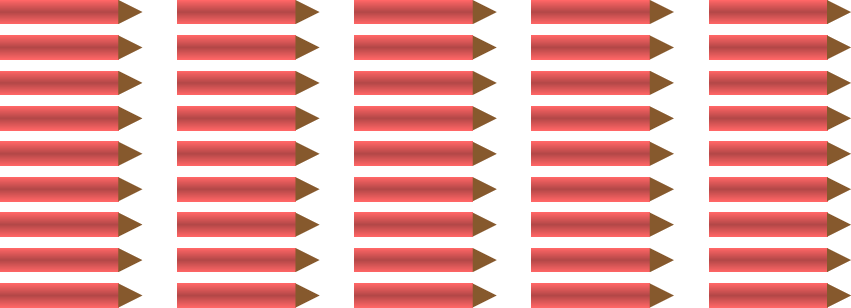
Hugo wants to find the total number of pencils needed. How can we help him figure this out?

Hugo could use repeated addition: $$9+9+9+9+9$$But this can be slow. A much faster way is to use multiplication:$$5 \times 9$$If we know our times tables, we know the answer instantly! Because we know that \(\textcolor{colordef}{5}\times \textcolor{colorprop}{9}=\textcolor{olive}{45}\), Hugo needs 45 pencils. This is why learning the times tables is so useful—they are a shortcut for solving problems quickly!


Definition Times Table
A times table is a helpful chart that shows the results of multiplying a number by other numbers (usually from 0 to 10). Each number has its own times table.
Example
Use the times table for 4 to calculate \(4\times 9\).$$\begin{aligned}\textcolor{colordef}{4}\times \textcolor{colorprop}{0}&=\textcolor{olive}{0}\\ \textcolor{colordef}{4}\times \textcolor{colorprop}{1}&=\textcolor{olive}{4}\\ \textcolor{colordef}{4}\times \textcolor{colorprop}{2}&=\textcolor{olive}{8 }\\ \textcolor{colordef}{4}\times \textcolor{colorprop}{3}&=\textcolor{olive}{12 }\\ \textcolor{colordef}{4}\times \textcolor{colorprop}{4}&=\textcolor{olive}{16 }\\ \textcolor{colordef}{4}\times \textcolor{colorprop}{5}&=\textcolor{olive}{20 }\\ \textcolor{colordef}{4}\times \textcolor{colorprop}{6}&=\textcolor{olive}{24 }\\ \textcolor{colordef}{4}\times \textcolor{colorprop}{7}&=\textcolor{olive}{28 }\\ \textcolor{colordef}{4}\times \textcolor{colorprop}{8}&=\textcolor{olive}{32 }\\ \textcolor{colordef}{4}\times \textcolor{colorprop}{9}&=\textcolor{olive}{36 }\\ \textcolor{colordef}{4}\times \textcolor{colorprop}{10}&=\textcolor{olive}{40}\end{aligned}$$

Looking at the times table for 4, we can find the line for \(4\times 9\) and see that the answer is 36.

Reviewing Our First Times Tables

Proposition Tables of 2, 3, 4, 5, and 10
\(\begin{aligned} \textcolor{colordef}{2}\times \textcolor{colorprop}{0}&=\textcolor{olive}{0}\\\textcolor{colordef}{2}\times \textcolor{colorprop}{1}&=\textcolor{olive}{2}\\ \textcolor{colordef}{2}\times \textcolor{colorprop}{2}&=\textcolor{olive}{4 }\\ \textcolor{colordef}{2}\times \textcolor{colorprop}{3}&=\textcolor{olive}{6 }\\ \textcolor{colordef}{2}\times \textcolor{colorprop}{4}&=\textcolor{olive}{8 }\\ \textcolor{colordef}{2}\times \textcolor{colorprop}{5}&=\textcolor{olive}{10 }\\ \textcolor{colordef}{2}\times \textcolor{colorprop}{6}&=\textcolor{olive}{12 }\\ \textcolor{colordef}{2}\times \textcolor{colorprop}{7}&=\textcolor{olive}{14 }\\ \textcolor{colordef}{2}\times \textcolor{colorprop}{8}&=\textcolor{olive}{16 }\\ \textcolor{colordef}{2}\times \textcolor{colorprop}{9}&=\textcolor{olive}{18 }\\ \textcolor{colordef}{2}\times \textcolor{colorprop}{10}&=\textcolor{olive}{20}\end{aligned}\) \(\quad \quad\) \(\begin{aligned}\textcolor{colordef}{3}\times \textcolor{colorprop}{0}&=\textcolor{olive}{0}\\\textcolor{colordef}{3}\times \textcolor{colorprop}{1}&=\textcolor{olive}{3}\\\textcolor{colordef}{3}\times \textcolor{colorprop}{2}&=\textcolor{olive}{6 }\\\textcolor{colordef}{3}\times \textcolor{colorprop}{3}&=\textcolor{olive}{9 }\\\textcolor{colordef}{3}\times \textcolor{colorprop}{4}&=\textcolor{olive}{12 }\\\textcolor{colordef}{3}\times \textcolor{colorprop}{5}&=\textcolor{olive}{15 }\\\textcolor{colordef}{3}\times \textcolor{colorprop}{6}&=\textcolor{olive}{18 }\\\textcolor{colordef}{3}\times \textcolor{colorprop}{7}&=\textcolor{olive}{21 }\\\textcolor{colordef}{3}\times \textcolor{colorprop}{8}&=\textcolor{olive}{24 }\\\textcolor{colordef}{3}\times \textcolor{colorprop}{9}&=\textcolor{olive}{27 }\\\textcolor{colordef}{3}\times \textcolor{colorprop}{10}&=\textcolor{olive}{30}\end{aligned}\) \(\quad \quad\) \(\begin{aligned}\textcolor{colordef}{4}\times \textcolor{colorprop}{0}&=\textcolor{olive}{0}\\\textcolor{colordef}{4}\times \textcolor{colorprop}{1}&=\textcolor{olive}{4}\\\textcolor{colordef}{4}\times \textcolor{colorprop}{2}&=\textcolor{olive}{8 }\\\textcolor{colordef}{4}\times \textcolor{colorprop}{3}&=\textcolor{olive}{12 }\\\textcolor{colordef}{4}\times \textcolor{colorprop}{4}&=\textcolor{olive}{16 }\\\textcolor{colordef}{4}\times \textcolor{colorprop}{5}&=\textcolor{olive}{20 }\\\textcolor{colordef}{4}\times \textcolor{colorprop}{6}&=\textcolor{olive}{24 }\\\textcolor{colordef}{4}\times \textcolor{colorprop}{7}&=\textcolor{olive}{28 }\\\textcolor{colordef}{4}\times \textcolor{colorprop}{8}&=\textcolor{olive}{32 }\\\textcolor{colordef}{4}\times \textcolor{colorprop}{9}&=\textcolor{olive}{36 }\\\textcolor{colordef}{4}\times \textcolor{colorprop}{10}&=\textcolor{olive}{40}\end{aligned}\) \(\quad \quad\) \(\begin{aligned}\textcolor{colordef}{5}\times \textcolor{colorprop}{0}&=\textcolor{olive}{0}\\\textcolor{colordef}{5}\times \textcolor{colorprop}{1}&=\textcolor{olive}{5}\\\textcolor{colordef}{5}\times \textcolor{colorprop}{2}&=\textcolor{olive}{10 }\\\textcolor{colordef}{5}\times \textcolor{colorprop}{3}&=\textcolor{olive}{15 }\\\textcolor{colordef}{5}\times \textcolor{colorprop}{4}&=\textcolor{olive}{20 }\\\textcolor{colordef}{5}\times \textcolor{colorprop}{5}&=\textcolor{olive}{25 }\\\textcolor{colordef}{5}\times \textcolor{colorprop}{6}&=\textcolor{olive}{30 }\\\textcolor{colordef}{5}\times \textcolor{colorprop}{7}&=\textcolor{olive}{35 }\\\textcolor{colordef}{5}\times \textcolor{colorprop}{8}&=\textcolor{olive}{40 }\\\textcolor{colordef}{5}\times \textcolor{colorprop}{9}&=\textcolor{olive}{45 }\\\textcolor{colordef}{5}\times \textcolor{colorprop}{10}&=\textcolor{olive}{50}\end{aligned}\) \(\quad \quad\) \(\begin{aligned}\textcolor{colordef}{10} \times \textcolor{colorprop}{0} &= \textcolor{olive}{0} \\\textcolor{colordef}{10} \times \textcolor{colorprop}{1} &= \textcolor{olive}{10} \\\textcolor{colordef}{10} \times \textcolor{colorprop}{2} &= \textcolor{olive}{20} \\\textcolor{colordef}{10} \times \textcolor{colorprop}{3} &= \textcolor{olive}{30} \\\textcolor{colordef}{10} \times \textcolor{colorprop}{4} &= \textcolor{olive}{40} \\\textcolor{colordef}{10} \times \textcolor{colorprop}{5} &= \textcolor{olive}{50} \\\textcolor{colordef}{10} \times \textcolor{colorprop}{6} &= \textcolor{olive}{60} \\\textcolor{colordef}{10} \times \textcolor{colorprop}{7} &= \textcolor{olive}{70} \\\textcolor{colordef}{10} \times \textcolor{colorprop}{8} &= \textcolor{olive}{80} \\\textcolor{colordef}{10} \times \textcolor{colorprop}{9} &= \textcolor{olive}{90} \\\textcolor{colordef}{10} \times \textcolor{colorprop}{10} &= \textcolor{olive}{100}\end{aligned}\)

The 6s Times Table


How many dots are there in total on these 4 dominoes?
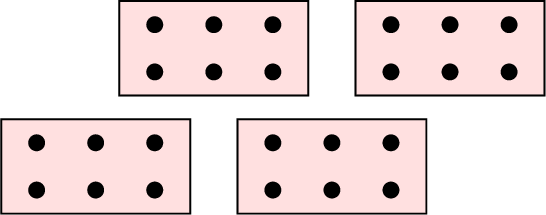
We have 4 groups of 6. We can skip-count by 6s: 6, 12, 18, 24.

There are \(4 \times 6 = 6 + 6 + 6 + 6 = 24\) dots.


Proposition Times Table of 6
\(\begin{aligned}\textcolor{colordef}{6}\times \textcolor{colorprop}{0}&=\textcolor{olive}{0}\\\textcolor{colordef}{6}\times \textcolor{colorprop}{1}&=\textcolor{olive}{6}\\\textcolor{colordef}{6}\times \textcolor{colorprop}{2}&=\textcolor{olive}{12 }\\\textcolor{colordef}{6}\times \textcolor{colorprop}{3}&=\textcolor{olive}{18 }\\\textcolor{colordef}{6}\times \textcolor{colorprop}{4}&=\textcolor{olive}{24 }\\\textcolor{colordef}{6}\times \textcolor{colorprop}{5}&=\textcolor{olive}{30 }\\\textcolor{colordef}{6}\times \textcolor{colorprop}{6}&=\textcolor{olive}{36 }\\\textcolor{colordef}{6}\times \textcolor{colorprop}{7}&=\textcolor{olive}{42 }\\\textcolor{colordef}{6}\times \textcolor{colorprop}{8}&=\textcolor{olive}{48 }\\\textcolor{colordef}{6}\times \textcolor{colorprop}{9}&=\textcolor{olive}{54 }\\\textcolor{colordef}{6}\times \textcolor{colorprop}{10}&=\textcolor{olive}{60}\end{aligned}\) \(\quad \quad\) \(\begin{aligned}\textcolor{colordef}{0}\times \textcolor{colorprop}{6}&=\textcolor{olive}{0}\\\textcolor{colordef}{1}\times \textcolor{colorprop}{6}&=\textcolor{olive}{6}\\\textcolor{colordef}{2}\times \textcolor{colorprop}{6}&=\textcolor{olive}{12}\\\textcolor{colordef}{3}\times \textcolor{colorprop}{6}&=\textcolor{olive}{18}\\\textcolor{colordef}{4}\times \textcolor{colorprop}{6}&=\textcolor{olive}{24}\\\textcolor{colordef}{5}\times \textcolor{colorprop}{6}&=\textcolor{olive}{30}\\\textcolor{colordef}{6}\times \textcolor{colorprop}{6}&=\textcolor{olive}{36}\\\textcolor{colordef}{7}\times \textcolor{colorprop}{6}&=\textcolor{olive}{42}\\\textcolor{colordef}{8}\times \textcolor{colorprop}{6}&=\textcolor{olive}{48}\\\textcolor{colordef}{9}\times \textcolor{colorprop}{6}&=\textcolor{olive}{54}\\\textcolor{colordef}{10}\times \textcolor{colorprop}{6}&=\textcolor{olive}{60}\end{aligned}\)

The 7s Times Table


There are 7 days in a week. How many days are there in 4 weeks?

We have 4 groups of 7. We can skip-count by 7s: 7, 14, 21, 28 days.

There are \(4 \times 7 = 7 + 7 + 7 + 7 = 28\) days.


Proposition Times Table of 7
\(\begin{aligned}\textcolor{colordef}{7}\times \textcolor{colorprop}{0}&=\textcolor{olive}{0}\\\textcolor{colordef}{7}\times \textcolor{colorprop}{1}&=\textcolor{olive}{7}\\\textcolor{colordef}{7}\times \textcolor{colorprop}{2}&=\textcolor{olive}{14 }\\\textcolor{colordef}{7}\times \textcolor{colorprop}{3}&=\textcolor{olive}{21 }\\\textcolor{colordef}{7}\times \textcolor{colorprop}{4}&=\textcolor{olive}{28 }\\\textcolor{colordef}{7}\times \textcolor{colorprop}{5}&=\textcolor{olive}{35 }\\\textcolor{colordef}{7}\times \textcolor{colorprop}{6}&=\textcolor{olive}{42 }\\\textcolor{colordef}{7}\times \textcolor{colorprop}{7}&=\textcolor{olive}{49 }\\\textcolor{colordef}{7}\times \textcolor{colorprop}{8}&=\textcolor{olive}{56 }\\\textcolor{colordef}{7}\times \textcolor{colorprop}{9}&=\textcolor{olive}{63 }\\\textcolor{colordef}{7}\times \textcolor{colorprop}{10}&=\textcolor{olive}{70}\end{aligned}\) \(\quad \quad\) \(\begin{aligned}\textcolor{colordef}{0}\times \textcolor{colorprop}{7}&=\textcolor{olive}{0}\\\textcolor{colordef}{1}\times \textcolor{colorprop}{7}&=\textcolor{olive}{7}\\\textcolor{colordef}{2}\times \textcolor{colorprop}{7}&=\textcolor{olive}{14}\\\textcolor{colordef}{3}\times \textcolor{colorprop}{7}&=\textcolor{olive}{21}\\\textcolor{colordef}{4}\times \textcolor{colorprop}{7}&=\textcolor{olive}{28}\\\textcolor{colordef}{5}\times \textcolor{colorprop}{7}&=\textcolor{olive}{35}\\\textcolor{colordef}{6}\times \textcolor{colorprop}{7}&=\textcolor{olive}{42}\\\textcolor{colordef}{7}\times \textcolor{colorprop}{7}&=\textcolor{olive}{49}\\\textcolor{colordef}{8}\times \textcolor{colorprop}{7}&=\textcolor{olive}{56}\\\textcolor{colordef}{9}\times \textcolor{colorprop}{7}&=\textcolor{olive}{63}\\\textcolor{colordef}{10}\times \textcolor{colorprop}{7}&=\textcolor{olive}{70}\end{aligned}\)

The 8s Times Table


A spider has 8 legs. How many legs do 4 spiders have altogether?
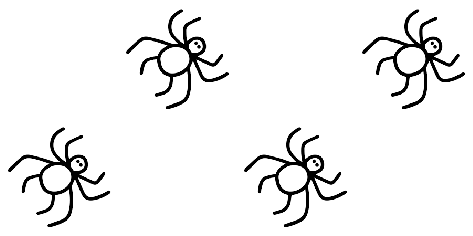
We have 4 groups of 8. We can skip-count by 8s: 8, 16, 24, 32 legs.

There are \(4 \times 8 = 8 + 8 + 8 + 8 = 32\) legs.


Proposition Times Table of 8
\(\begin{aligned}\textcolor{colordef}{8}\times \textcolor{colorprop}{0}&=\textcolor{olive}{0}\\\textcolor{colordef}{8}\times \textcolor{colorprop}{1}&=\textcolor{olive}{8}\\\textcolor{colordef}{8}\times \textcolor{colorprop}{2}&=\textcolor{olive}{16 }\\\textcolor{colordef}{8}\times \textcolor{colorprop}{3}&=\textcolor{olive}{24 }\\\textcolor{colordef}{8}\times \textcolor{colorprop}{4}&=\textcolor{olive}{32 }\\\textcolor{colordef}{8}\times \textcolor{colorprop}{5}&=\textcolor{olive}{40 }\\\textcolor{colordef}{8}\times \textcolor{colorprop}{6}&=\textcolor{olive}{48 }\\\textcolor{colordef}{8}\times \textcolor{colorprop}{7}&=\textcolor{olive}{56 }\\\textcolor{colordef}{8}\times \textcolor{colorprop}{8}&=\textcolor{olive}{64 }\\\textcolor{colordef}{8}\times \textcolor{colorprop}{9}&=\textcolor{olive}{72 }\\\textcolor{colordef}{8}\times \textcolor{colorprop}{10}&=\textcolor{olive}{80}\end{aligned}\) \(\quad \quad\) \(\begin{aligned}\textcolor{colordef}{0}\times \textcolor{colorprop}{8}&=\textcolor{olive}{0}\\\textcolor{colordef}{1}\times \textcolor{colorprop}{8}&=\textcolor{olive}{8}\\\textcolor{colordef}{2}\times \textcolor{colorprop}{8}&=\textcolor{olive}{16}\\\textcolor{colordef}{3}\times \textcolor{colorprop}{8}&=\textcolor{olive}{24}\\\textcolor{colordef}{4}\times \textcolor{colorprop}{8}&=\textcolor{olive}{32}\\\textcolor{colordef}{5}\times \textcolor{colorprop}{8}&=\textcolor{olive}{40}\\\textcolor{colordef}{6}\times \textcolor{colorprop}{8}&=\textcolor{olive}{48}\\\textcolor{colordef}{7}\times \textcolor{colorprop}{8}&=\textcolor{olive}{56}\\\textcolor{colordef}{8}\times \textcolor{colorprop}{8}&=\textcolor{olive}{64}\\\textcolor{colordef}{9}\times \textcolor{colorprop}{8}&=\textcolor{olive}{72}\\\textcolor{colordef}{10}\times \textcolor{colorprop}{8}&=\textcolor{olive}{80}\end{aligned}\)

The 9s Times Table


There are 9 players on a baseball team. How many players are in 5 teams?

We have 5 groups of 9. We can skip-count by 9s: 9, 18, 27, 36, 45 players.

There are \(5 \times 9 = 9 + 9 + 9 + 9 + 9 = 45\) players.


Proposition Times Table of 9
\(\begin{aligned}\textcolor{colordef}{9}\times \textcolor{colorprop}{0}&=\textcolor{olive}{0}\\\textcolor{colordef}{9}\times \textcolor{colorprop}{1}&=\textcolor{olive}{9}\\\textcolor{colordef}{9}\times \textcolor{colorprop}{2}&=\textcolor{olive}{18 }\\\textcolor{colordef}{9}\times \textcolor{colorprop}{3}&=\textcolor{olive}{27 }\\\textcolor{colordef}{9}\times \textcolor{colorprop}{4}&=\textcolor{olive}{36 }\\\textcolor{colordef}{9}\times \textcolor{colorprop}{5}&=\textcolor{olive}{45 }\\\textcolor{colordef}{9}\times \textcolor{colorprop}{6}&=\textcolor{olive}{54 }\\\textcolor{colordef}{9}\times \textcolor{colorprop}{7}&=\textcolor{olive}{63 }\\\textcolor{colordef}{9}\times \textcolor{colorprop}{8}&=\textcolor{olive}{72 }\\\textcolor{colordef}{9}\times \textcolor{colorprop}{9}&=\textcolor{olive}{81 }\\\textcolor{colordef}{9}\times \textcolor{colorprop}{10}&=\textcolor{olive}{90}\end{aligned}\) \(\quad \quad\) \(\begin{aligned}\textcolor{colordef}{0}\times \textcolor{colorprop}{9}&=\textcolor{olive}{0}\\\textcolor{colordef}{1}\times \textcolor{colorprop}{9}&=\textcolor{olive}{9}\\\textcolor{colordef}{2}\times \textcolor{colorprop}{9}&=\textcolor{olive}{18}\\\textcolor{colordef}{3}\times \textcolor{colorprop}{9}&=\textcolor{olive}{27}\\\textcolor{colordef}{4}\times \textcolor{colorprop}{9}&=\textcolor{olive}{36}\\\textcolor{colordef}{5}\times \textcolor{colorprop}{9}&=\textcolor{olive}{45}\\\textcolor{colordef}{6}\times \textcolor{colorprop}{9}&=\textcolor{olive}{54}\\\textcolor{colordef}{7}\times \textcolor{colorprop}{9}&=\textcolor{olive}{63}\\\textcolor{colordef}{8}\times \textcolor{colorprop}{9}&=\textcolor{olive}{72}\\\textcolor{colordef}{9}\times \textcolor{colorprop}{9}&=\textcolor{olive}{81}\\\textcolor{colordef}{10}\times \textcolor{colorprop}{9}&=\textcolor{olive}{90}\end{aligned}\)

The Full Multiplication Grid

Proposition All Times Tables from 1 to 10
This grid is a powerful tool that shows all the times tables from 1 to 10 in one place. To find the answer to a problem like \(7 \times 8\), find the row for 7 and the column for 8, and see where they meet!
\(\times\) \(\textcolor{colorprop}{1}\) \(\textcolor{colorprop}{2}\) \(\textcolor{colorprop}{3}\) \(\textcolor{colorprop}{4}\) \(\textcolor{colorprop}{5}\) \(\textcolor{colorprop}{6}\) \(\textcolor{colorprop}{7}\) \(\textcolor{colorprop}{8}\) \(\textcolor{colorprop}{9}\) \(\textcolor{colorprop}{10}\)
\(\textcolor{colordef}{1}\) \(\textcolor{olive}{1}\) \(\textcolor{olive}{2}\) \(\textcolor{olive}{3}\) \(\textcolor{olive}{4}\) \(\textcolor{olive}{5}\) \(\textcolor{olive}{6}\) \(\textcolor{olive}{7}\) \(\textcolor{olive}{8}\) \(\textcolor{olive}{9}\) \(\textcolor{olive}{10}\)
\(\textcolor{colordef}{2}\) \(\textcolor{olive}{2}\) \(\textcolor{olive}{4}\) \(\textcolor{olive}{6}\) \(\textcolor{olive}{8}\) \(\textcolor{olive}{10}\) \(\textcolor{olive}{12}\) \(\textcolor{olive}{14}\) \(\textcolor{olive}{16}\) \(\textcolor{olive}{18}\) \(\textcolor{olive}{20}\)
\(\textcolor{colordef}{3}\) \(\textcolor{olive}{3}\) \(\textcolor{olive}{6}\) \(\textcolor{olive}{9}\) \(\textcolor{olive}{12}\) \(\textcolor{olive}{15}\) \(\textcolor{olive}{18}\) \(\textcolor{olive}{21}\) \(\textcolor{olive}{24}\) \(\textcolor{olive}{27}\) \(\textcolor{olive}{30}\)
\(\textcolor{colordef}{4}\) \(\textcolor{olive}{4}\) \(\textcolor{olive}{8}\) \(\textcolor{olive}{12}\) \(\textcolor{olive}{16}\) \(\textcolor{olive}{20}\) \(\textcolor{olive}{24}\) \(\textcolor{olive}{28}\) \(\textcolor{olive}{32}\) \(\textcolor{olive}{36}\) \(\textcolor{olive}{40}\)
\(\textcolor{colordef}{5}\) \(\textcolor{olive}{5}\) \(\textcolor{olive}{10}\) \(\textcolor{olive}{15}\) \(\textcolor{olive}{20}\) \(\textcolor{olive}{25}\) \(\textcolor{olive}{30}\) \(\textcolor{olive}{35}\) \(\textcolor{olive}{40}\) \(\textcolor{olive}{45}\) \(\textcolor{olive}{50}\)
\(\textcolor{colordef}{6}\) \(\textcolor{olive}{6}\) \(\textcolor{olive}{12}\) \(\textcolor{olive}{18}\) \(\textcolor{olive}{24}\) \(\textcolor{olive}{30}\) \(\textcolor{olive}{36}\) \(\textcolor{olive}{42}\) \(\textcolor{olive}{48}\) \(\textcolor{olive}{54}\) \(\textcolor{olive}{60}\)
\(\textcolor{colordef}{7}\) \(\textcolor{olive}{7}\) \(\textcolor{olive}{14}\) \(\textcolor{olive}{21}\) \(\textcolor{olive}{28}\) \(\textcolor{olive}{35}\) \(\textcolor{olive}{42}\) \(\textcolor{olive}{49}\) \(\textcolor{olive}{56}\) \(\textcolor{olive}{63}\) \(\textcolor{olive}{70}\)
\(\textcolor{colordef}{8}\) \(\textcolor{olive}{8}\) \(\textcolor{olive}{16}\) \(\textcolor{olive}{24}\) \(\textcolor{olive}{32}\) \(\textcolor{olive}{40}\) \(\textcolor{olive}{48}\) \(\textcolor{olive}{56}\) \(\textcolor{olive}{64}\) \(\textcolor{olive}{72}\) \(\textcolor{olive}{80}\)
\(\textcolor{colordef}{9}\) \(\textcolor{olive}{9}\) \(\textcolor{olive}{18}\) \(\textcolor{olive}{27}\) \(\textcolor{olive}{36}\) \(\textcolor{olive}{45}\) \(\textcolor{olive}{54}\) \(\textcolor{olive}{63}\) \(\textcolor{olive}{72}\) \(\textcolor{olive}{81}\) \(\textcolor{olive}{90}\)
\(\textcolor{colordef}{10}\) \(\textcolor{olive}{10}\) \(\textcolor{olive}{20}\) \(\textcolor{olive}{30}\) \(\textcolor{olive}{40}\) \(\textcolor{olive}{50}\) \(\textcolor{olive}{60}\) \(\textcolor{olive}{70}\) \(\textcolor{olive}{80}\) \(\textcolor{olive}{90}\) \(\textcolor{olive}{100}\)