Reference Functions
Introduction
In mathematics, reference functions are fundamental building blocks that help us understand more complex relationships. This chapter explores the following functions:
- Square Function: \(f(x) = x^2\)
- Square Root Function: \(f(x) = \sqrt{x}\)
- Cube Function: \(f(x) = x^3\)
- Inverse Function: \(f(x) = \frac{1}{x}\)
Square Function
Definition Square Function
The square function is defined on \(\mathbb{R}\) by \(f(x) = x^2\). This means that each input value \(x\) is multiplied by itself to give the output.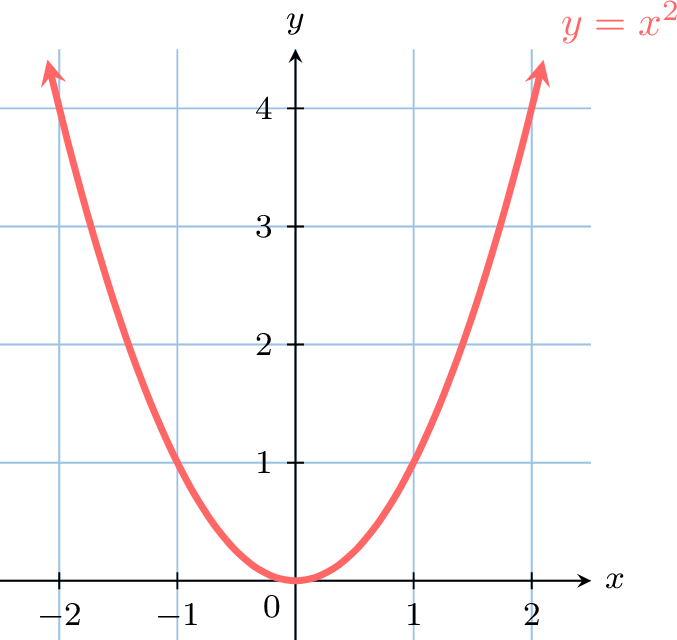
- Domain: All real numbers (\(\mathbb{R}\)).
- Shape: A curve called a parabola opening upwards.
Proposition Properties
- For any real number \(x\), \(x^2 \geqslant 0\).
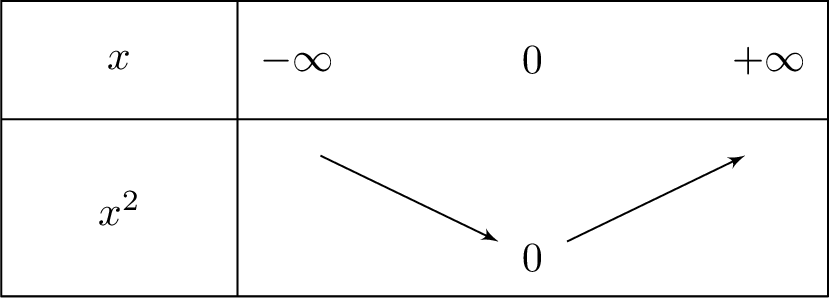
- The square function is strictly decreasing on \((-\infty, 0]\) and strictly increasing on \([0, +\infty)\).
- The square function is even: its graph is symmetric with respect to the \(y\)-axis (\(f(-x) = f(x)\)).
Let \(f(x) = x^2\).
- The product of two real numbers with the same sign is always non-negative, so \(x^2 = x \times x \geqslant 0\).
- Parity: \(f(-x) = (-x)^2 = (-x) \times (-x) = x^2 = f(x)\). Thus, \(f\) is even.
- Variations:
- Let \(a\) and \(b\) be two real numbers such that \(0 \leqslant a < b\).$$f(b) - f(a) = b^2 - a^2 = (b - a)(b + a)$$Since \(b > a\), then \((b - a) > 0\). Since \(a\) and \(b\) are non-negative and not both zero, \((b + a) > 0\).
The product is positive, so \(f(b) - f(a) > 0\), meaning \(f(a) < f(b)\). \(f\) is strictly increasing on \([0, +\infty)\). - Let \(a\) and \(b\) be two real numbers such that \(a < b \leqslant 0\).
In this case, \((b - a) > 0\) but \((b + a) < 0\).
The product is negative, so \(f(b) - f(a) < 0\), meaning \(f(a) > f(b)\). \(f\) is strictly decreasing on \((-\infty, 0]\).
- Let \(a\) and \(b\) be two real numbers such that \(0 \leqslant a < b\).$$f(b) - f(a) = b^2 - a^2 = (b - a)(b + a)$$Since \(b > a\), then \((b - a) > 0\). Since \(a\) and \(b\) are non-negative and not both zero, \((b + a) > 0\).
Example
The area of a square with side length \(x\) is given by \(A(x) = x^2\). 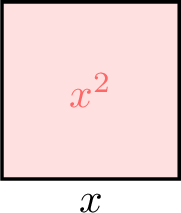
If \(x = 4\) m, then \(A(4) = 4^2 = 16\) m\(^2\).
Square Root Function
Definition Square Root Function
The square root function is defined on \([0, +\infty)\) by \(f(x) = \sqrt{x}\). For any non-negative \(x\), \(\sqrt{x}\) is the unique non-negative number whose square is \(x\).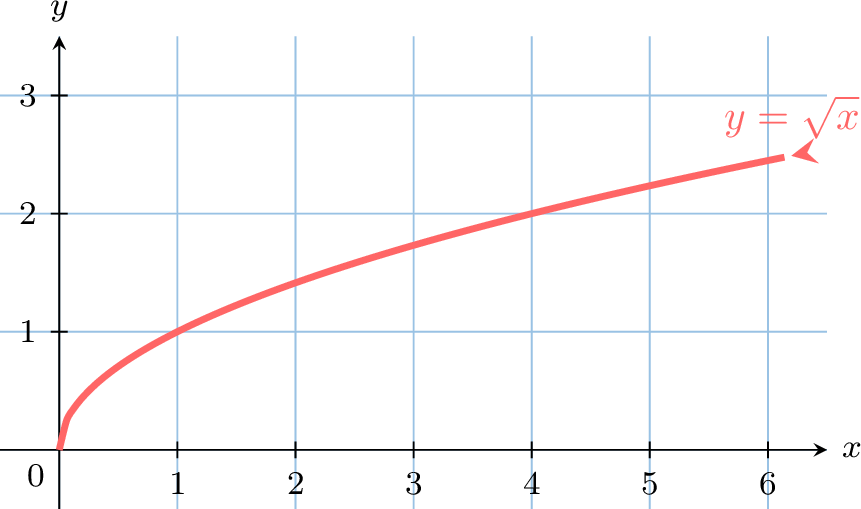
- Domain: \([0, +\infty)\) (non-negative real numbers).
- Shape: A curve starting at the origin \((0,0)\) and increasing.
Proposition Properties
The square root function is strictly increasing on \([0, +\infty)\).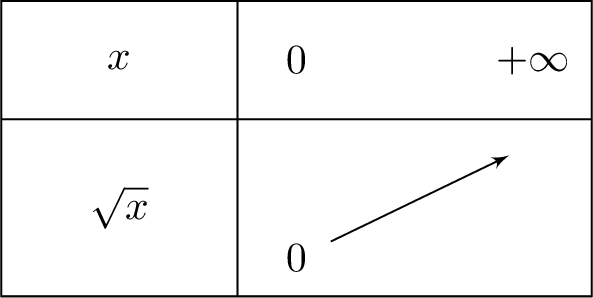
Let \(f(x) = \sqrt{x}\). Let \(a\) and \(b\) be two real numbers such that \(0 \leqslant a < b\).$$\begin{aligned}[t]f(b) - f(a) &= \sqrt{b} - \sqrt{a} \\
&= \frac{(\sqrt{b} - \sqrt{a})(\sqrt{b} + \sqrt{a})}{\sqrt{b} + \sqrt{a}} \\
&= \frac{(\sqrt{b})^2 - (\sqrt{a})^2}{\sqrt{b} + \sqrt{a}}\\
&= \frac{b - a}{\sqrt{b} + \sqrt{a}}\end{aligned}$$Since \(b > a\), the numerator \((b - a)\) is positive. The denominator is a sum of square roots of two non-negative numbers (not both zero), so it is positive.
Thus, \(f(b) - f(a) > 0\), so \(f(a) < f(b)\).
Thus, \(f(b) - f(a) > 0\), so \(f(a) < f(b)\).
Cube Function
Definition Cube Function
The cube function is defined on \(\mathbb{R}\) by \(f(x) = x^3\).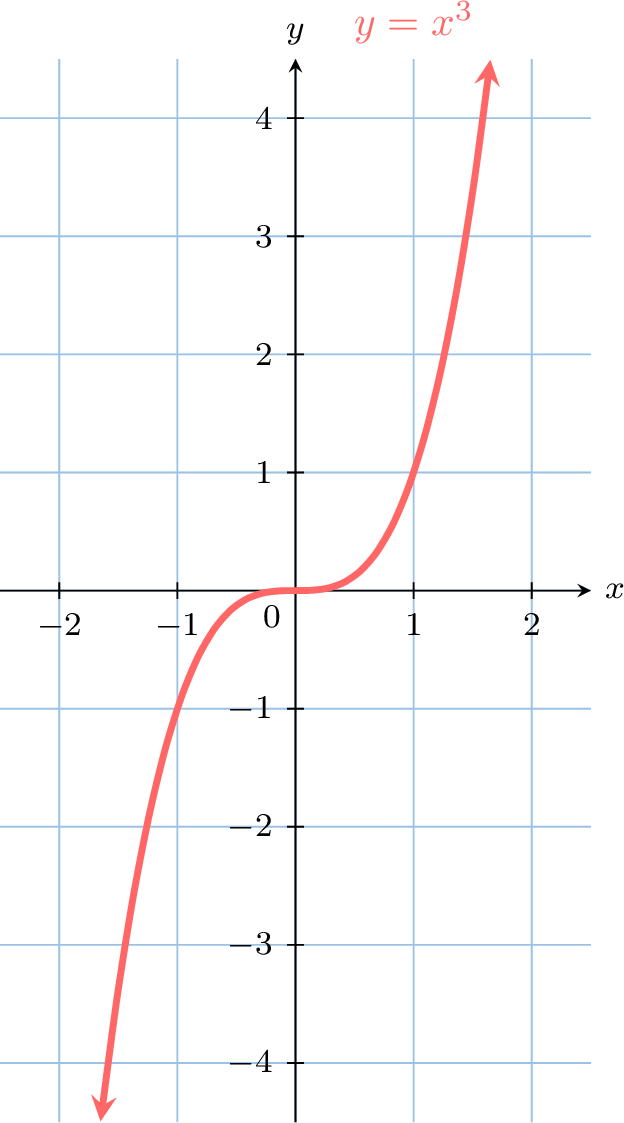
Proposition Properties
- The cube function is strictly increasing on \(\mathbb{R}\).
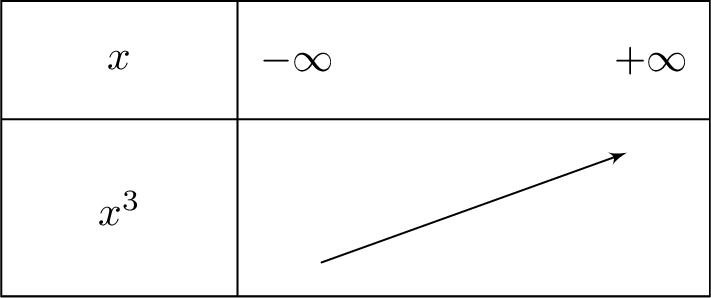
- The cube function is odd: its graph is symmetric with respect to the origin \((0,0)\).
Parity: \(f(-x) = (-x)^3 = (-x) \times (-x) \times (-x) = -x^3 = -f(x)\).Thus, \(f\) is odd.
Example
The volume of a cube with side length \(x\) is \(V(x) = x^3\).
Inverse Function
Definition Inverse Function
The inverse function is defined on \(\mathbb{R}^*\) (all real numbers except \(0\)) by \(f(x) = \frac{1}{x}\).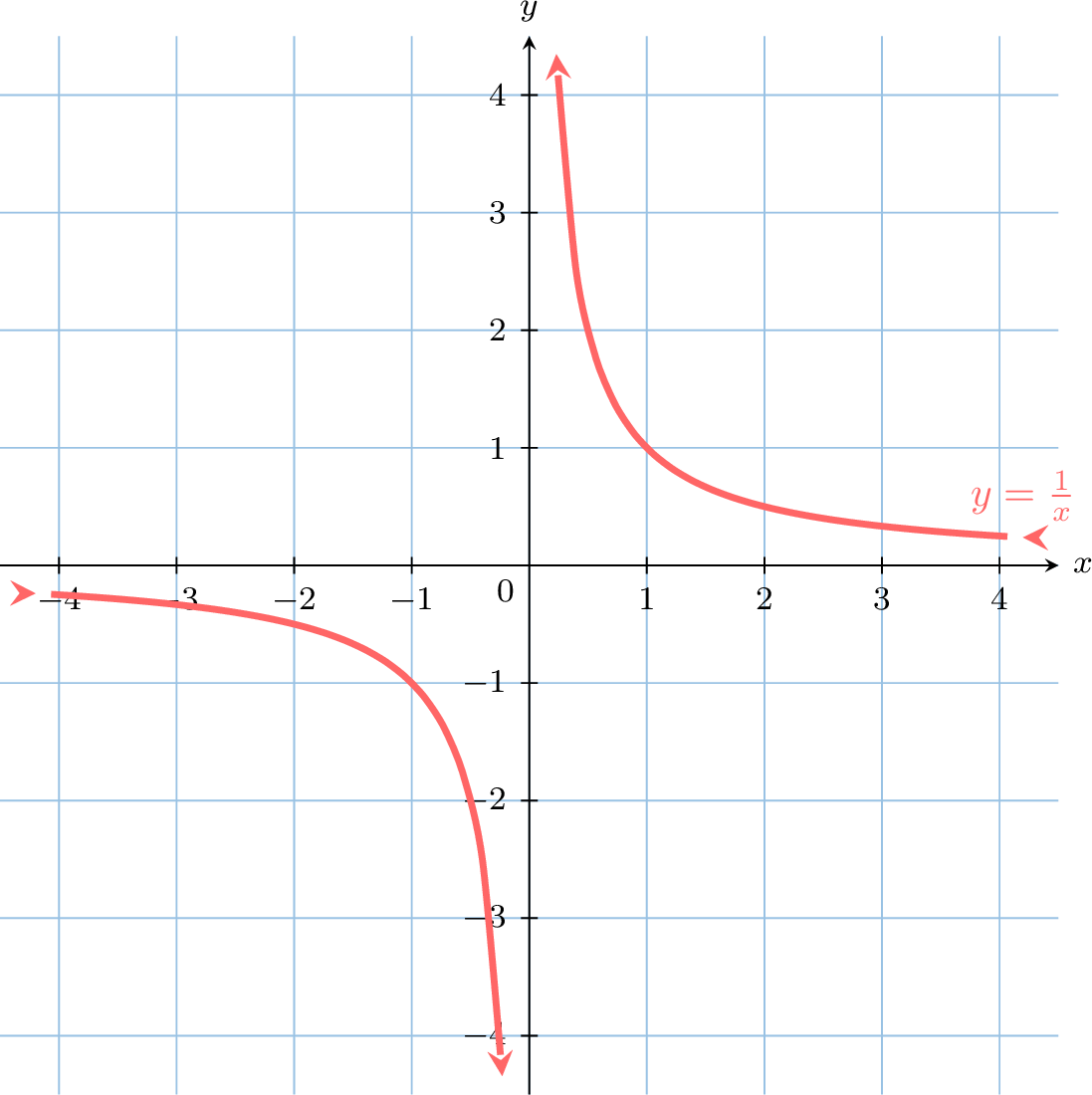
- Domain: \(\mathbb{R} \setminus \{0\}\), also written \((-\infty, 0) \cup (0, +\infty)\).
- Shape: A curve called a hyperbola.
Proposition Properties
- The inverse function is strictly decreasing on \((-\infty, 0)\) and strictly decreasing on \((0, +\infty)\).
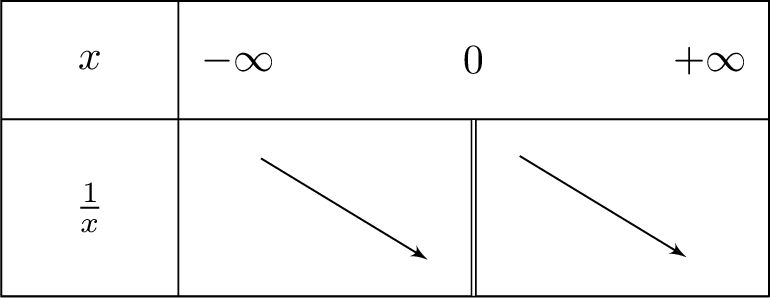
- The inverse function is odd (symmetric about the origin).
Let \(a\) and \(b\) be two real numbers such that \(0 < a < b\).$$f(b) - f(a) = \frac{1}{b} - \frac{1}{a} = \frac{a - b}{ab}$$Since \(a < b\), then \((a - b) < 0\). Since \(a\) and \(b\) are positive, \(ab > 0\).
The quotient is negative, so \(f(b) < f(a)\). The order is reversed; \(f\) is strictly decreasing on \((0, +\infty)\).
The quotient is negative, so \(f(b) < f(a)\). The order is reversed; \(f\) is strictly decreasing on \((0, +\infty)\).