Exponential Function
The exponential function is a unique mathematical tool used to model phenomena that grow or decay at a rate proportional to their size, such as population growth, radioactive decay, or compound interest. Its most remarkable property is that it is its own derivative.
Definition
Definition Exponential Function
There exists a unique differentiable function \(f\) on \(\mathbb{R}\), called the exponential function and denoted by \(\exp\), such that: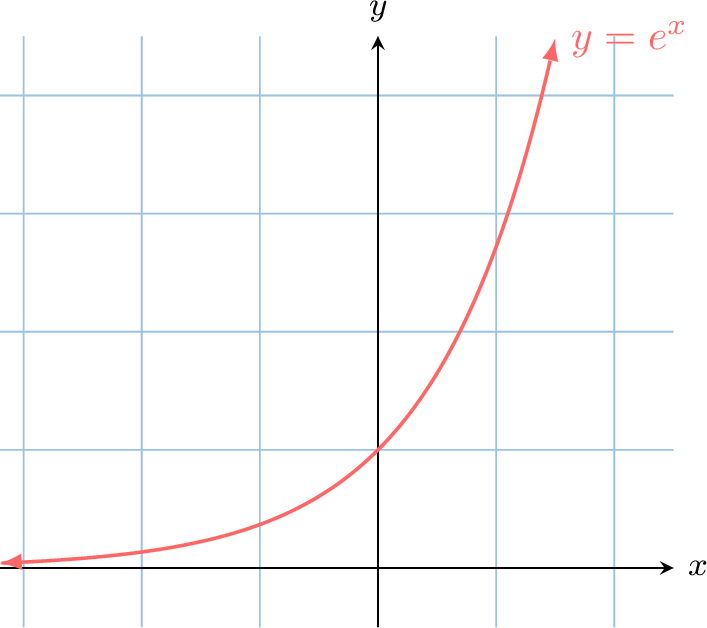
- \(f'(x) = f(x)\) for all \(x \in \mathbb{R}\) (the function is equal to its own derivative).
- \(f(0) = 1\).
Proposition Derivative Property
By definition, for all \(x \in \mathbb{R}\):$$\exp'(x) = \exp(x)$$
Algebraic Properties and Notation
Proposition Fundamental Functional Relation
For all real numbers \(x\) and \(y\):$$\exp(x + y) = \exp(x) \times \exp(y)$$
Proposition Strict Positivity
The function \(\exp\) is strictly positive on \(\mathbb{R}\): for all \(x \in \mathbb{R}\), \(\exp(x) > 0\).
- For any real \(x\), \(\exp(x) = \exp\left(\frac{x}{2} + \frac{x}{2}\right) = \left[\exp\left(\frac{x}{2}\right)\right]^2\).
- Since a square is always non-negative, \(\exp(x) \geqslant 0\).
- We know \(\exp(x) \times \exp(-x) = \exp(x-x) = \exp(0) = 1\).
- If there existed an \(x\) such that \(\exp(x) = 0\), then \(0 \times \exp(-x) = 1\), which means \(0 = 1\). This is impossible.
- Therefore, \(\exp(x)\) is never zero and must be strictly positive.
Definition The Constant \(e\) and Power Notation
The number \(\exp(1)\) is denoted by \(e\). Its approximate value is \(e \approx 2.718\).For any real \(x\), it follows that \(\exp(x) = \exp(1 \cdot x) = [\exp(1)]^x = e^x\). We now note:$$\exp(x) = e^x$$
Proposition Algebraic Rules
For all real numbers \(x, y\) and any integer \(n\):
- \(e^0 = 1\) and \(e^1 = e\)
- \(e^{x+y} = e^x \times e^y\)
- \(e^{-x} = \dfrac{1}{e^x}\)
- \(e^{x-y} = \dfrac{e^x}{e^y}\)
- \((e^x)^n = e^{nx}\)
Study of the Function
Proposition Variations
The exponential function is strictly increasing on \(\mathbb{R}\).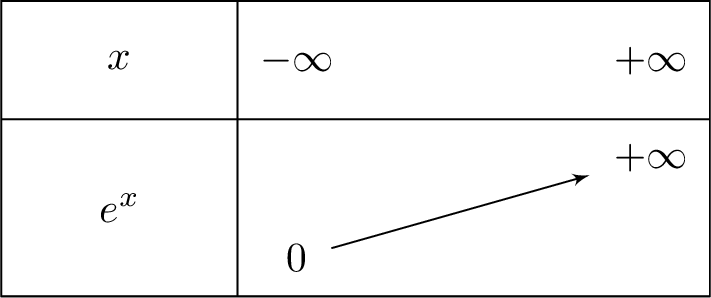
The derivative of \(f(x) = e^x\) is \(f'(x) = e^x\).
As proved previously, \(e^x > 0\) for all real \(x\). Since the derivative is strictly positive, the function is strictly increasing.
As proved previously, \(e^x > 0\) for all real \(x\). Since the derivative is strictly positive, the function is strictly increasing.
Proposition Derivative of \(e^{u(x)}\)
Let \(u\) be a differentiable function on an interval \(I\). The function \(f\) defined by \(f(x) = e^{u(x)}\) is differentiable on \(I\) and its derivative is:$$\textcolor{colorprop}{\left(e^{u(x)}\right)' = u'(x) e^{u(x)}}$$Linear Application:
In the specific case where \(u(x) = ax + b\) (with \(a\) and \(b\) real constants), the derivative is:$$\textcolor{colorprop}{\left(e^{ax+b}\right)' = a e^{ax+b}}$$
In the specific case where \(u(x) = ax + b\) (with \(a\) and \(b\) real constants), the derivative is:$$\textcolor{colorprop}{\left(e^{ax+b}\right)' = a e^{ax+b}}$$
Example
Let \(f(x)=e^{5x-3}\). Set \(u(x)=5x-3\), so \(u'(x)=5\). Therefore,$$f'(x)=u'(x)\,e^{u(x)}=5e^{5x-3}.$$
Proposition Growth and Decay Models
Let \(k\) be a non-zero real constant. The variation of the function \(f: t \mapsto e^{kt}\) depends on the sign of \(k\):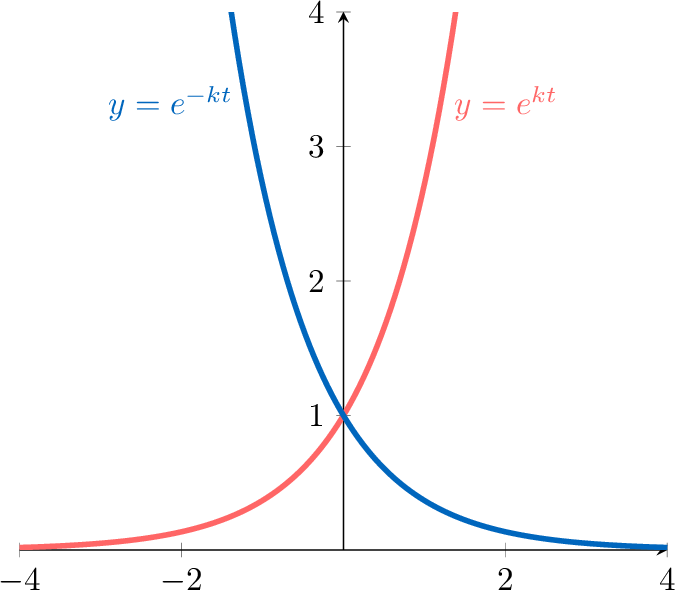
- If \(\boldsymbol{k > 0}\), the function is strictly increasing (Exponential Growth).
- If \(\boldsymbol{k < 0}\), the function is strictly decreasing (Exponential Decay).