Monotonicity of Sequences
Definition
Definition Increasing and Decreasing Sequences
Let \((u_n)\) be a sequence.
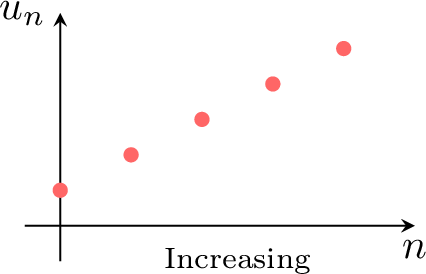
- The sequence \((u_n)\) is increasing from index \(n_0\) if for all \(n \ge n_0\), \(\boldsymbol{u_{n+1} \ge u_n}\).
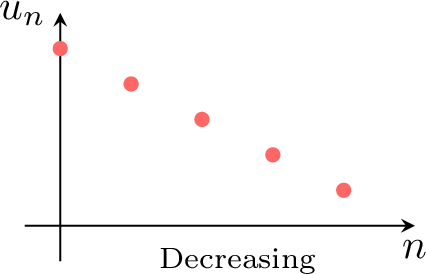
- The sequence \((u_n)\) is decreasing from index \(n_0\) if for all \(n \ge n_0\), \(\boldsymbol{u_{n+1} \le u_n}\).
- A sequence that is either increasing or decreasing is said to be monotonic.
Note
- Just like with functions, if we replace the non-strict inequalities with strict ones, we speak of a strictly increasing or strictly decreasing sequence.
- Some sequences are not monotonic, such as the sequence \((u_n)\) defined by \(u_n = (-1)^n\), which alternates between \(1\) and \(-1\).
Studying the Variations of a Sequence
Method Studying the Sign of the Difference \(u_{n+1}-u_n\)
To study the monotonicity of a sequence \((u_n)\), we can determine the sign of the difference between two consecutive terms:
- If for all \(n\geq n_0\), \(\textcolor{colorprop}{u_{n+1} - u_n \ge 0}\), the sequence is increasing from index \(n_0\).
- If for all \(n\geq n_0\), \(\textcolor{colorprop}{u_{n+1} - u_n \le 0}\), the sequence is decreasing from index \(n_0\).
Example
Study the variations of the sequence \((u_n)\) defined by \(u_n = 2n - 3\).
Let \(n \in \mathbb{N}\).$$\begin{aligned}u_{n+1} - u_n &= [2(n+1) - 3] - [2n - 3] \\
&= 2n + 2 - 3 - 2n + 3 \\
&= 2\end{aligned}$$Since \(2 > 0\), the sequence \((u_n)\) is strictly increasing.
Method Comparing the Ratio \(\frac{u_{n+1}}{u_n}\) to 1
For a sequence with strictly positive terms (\(u_n > 0\)):
- If for all \(n\geq n_0\), \(\textcolor{colorprop}{\frac{u_{n+1}}{u_n} \geq 1}\), the sequence is increasing from index \(n_0\)..
- If for all \(n\geq n_0\), \(\textcolor{colorprop}{\frac{u_{n+1}}{u_n} \leq 1}\), the sequence is decreasing from index \(n_0\)..
Example
Study the variations of the sequence \((u_n)\) defined by \(u_n = 2^n\).
Let \(n \in \mathbb{N}\).
All terms are positive (\(2^n > 0\)).$$\begin{aligned} \frac{u_{n+1}}{u_n} &= \frac{2^{n+1}}{2^n}\\ &= 2^{n+1-n}\\ &= 2 \\ \end{aligned}$$Since \(2 > 1\), the sequence \((u_n)\) is strictly increasing.
All terms are positive (\(2^n > 0\)).$$\begin{aligned} \frac{u_{n+1}}{u_n} &= \frac{2^{n+1}}{2^n}\\ &= 2^{n+1-n}\\ &= 2 \\ \end{aligned}$$Since \(2 > 1\), the sequence \((u_n)\) is strictly increasing.