Link Between Addition and Subtraction
Understanding Inverse Operations
Addition and subtraction are partners that undo each other. Think of them as a team!
Let's see how they work together.
Let's see how they work together.
- First, we add. If you have 3 red blocks and you get 2 blue blocks, you have 5 blocks in total. $$ 3 + 2 = 5 $$

- Now, we subtract. If you start with those 5 blocks and take away the 2 blue ones, you are left with the 3 red blocks you started with. $$ 5 - 2 = 3 $$

Proposition Link Between Addition and Subtraction
$$\textcolor{colordef}{\text{part 1}} + \textcolor{colorprop}{\text{part 2}}=\textcolor{olive}{\text{total}}$$$$\textcolor{olive}{\text{total}} -\textcolor{colordef}{\text{part 1}} = \textcolor{colorprop}{\text{part 2}} \quad\quad \textcolor{olive}{\text{total}} -\textcolor{colorprop}{\text{part 2}} =\textcolor{colordef}{\text{part 1}} $$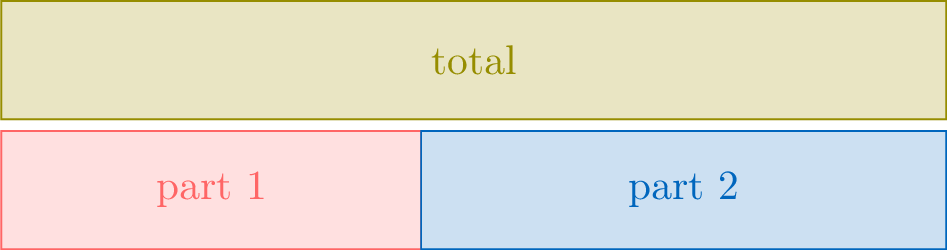
Example
$$ \textcolor{colordef}{8} + \textcolor{colorprop}{6}=\textcolor{olive}{14} $$$$ \textcolor{olive}{14} - \textcolor{colorprop}{6} = \textcolor{colordef}{8}\qquad \textcolor{olive}{14}- \textcolor{colordef}{8} = \textcolor{colorprop}{6} $$
Method Using Addition to Solve Subtraction (Counting Up)
Because addition and subtraction are linked, you can solve a subtraction problem by thinking of it as a "missing part" addition problem.
To solve \(\textcolor{olive}{13} - \textcolor{colordef}{9}\), ask yourself: "What do I add to 9 to make 13?"
To solve \(\textcolor{olive}{13} - \textcolor{colordef}{9}\), ask yourself: "What do I add to 9 to make 13?"
- Start at \(\textcolor{colordef}{9}\).
- Count up until you reach \(\textcolor{olive}{13}\): "10, 11, 12, 13."
- How many numbers did you count? You counted \(\textcolor{colorprop}{4}\) numbers.
Problem-Solving with Part-Whole Models
Method Steps to Solve Word Problems
- Understand the Story: Read the problem to identify the parts and the whole.
- Draw a Model: Use a part-whole bar model to organize the information.
- Choose the Operation: If the whole is unknown, you add the parts. If a part is unknown, you subtract the known part from the whole.
- Solve and Check: Calculate the answer and make sure it makes sense in the context of the story.
Example
You have 5 candies, and your friend gives you 3 more. How many candies do you have in total?
- Analysis: We know the two parts (5 and 3) and need to find the whole (total). We must add.
- Model:

- Solve: \(\textcolor{colordef}{5}+\textcolor{colorprop}{3}=\textcolor{olive}{8}\). You have \(\textcolor{olive}{8}\) candies in total.