\( \definecolor{colordef}{RGB}{249,49,84} \definecolor{colorprop}{RGB}{18,102,241} \)

Times Tables

A Tool for Fast Multiplication


There are 5 empty boxes, and each box needs 9 pencils to be full.
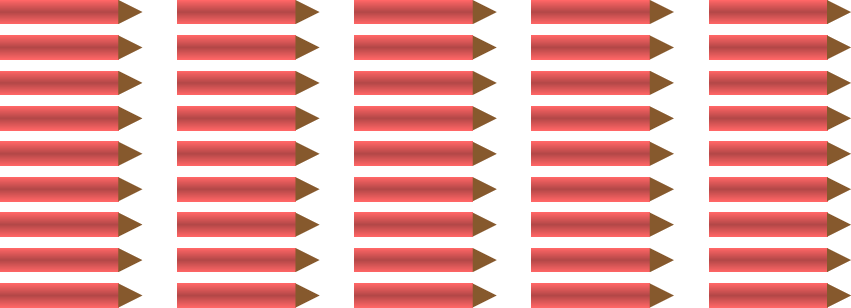
Hugo wants to find the total number of pencils needed. How can we help him figure this out?

Hugo could use repeated addition: $$9+9+9+9+9$$But this can be slow. A much faster way is to use multiplication:$$5 \times 9$$If we know our times tables, we know the answer instantly! Because we know that \(\textcolor{colordef}{5}\times \textcolor{colorprop}{9}=\textcolor{olive}{45}\), Hugo needs 45 pencils. This is why learning the times tables is so useful—they are a shortcut for solving problems quickly!


Definition Times Table
A times table is a helpful chart that shows the results of multiplying a number by other numbers (usually from 0 to 10). Each number has its own times table.
Example
Use the times table for 4 to calculate \(4\times 9\).$$\begin{aligned}\textcolor{colordef}{4}\times \textcolor{colorprop}{0}&=\textcolor{olive}{0}\\ \textcolor{colordef}{4}\times \textcolor{colorprop}{1}&=\textcolor{olive}{4}\\ \textcolor{colordef}{4}\times \textcolor{colorprop}{2}&=\textcolor{olive}{8 }\\ \textcolor{colordef}{4}\times \textcolor{colorprop}{3}&=\textcolor{olive}{12 }\\ \textcolor{colordef}{4}\times \textcolor{colorprop}{4}&=\textcolor{olive}{16 }\\ \textcolor{colordef}{4}\times \textcolor{colorprop}{5}&=\textcolor{olive}{20 }\\ \textcolor{colordef}{4}\times \textcolor{colorprop}{6}&=\textcolor{olive}{24 }\\ \textcolor{colordef}{4}\times \textcolor{colorprop}{7}&=\textcolor{olive}{28 }\\ \textcolor{colordef}{4}\times \textcolor{colorprop}{8}&=\textcolor{olive}{32 }\\ \textcolor{colordef}{4}\times \textcolor{colorprop}{9}&=\textcolor{olive}{36 }\\ \textcolor{colordef}{4}\times \textcolor{colorprop}{10}&=\textcolor{olive}{40}\end{aligned}$$

Looking at the times table for 4, we can find the line for \(4\times 9\) and see that the answer is 36.

The 2s Times Table


How many eyes are there in total?
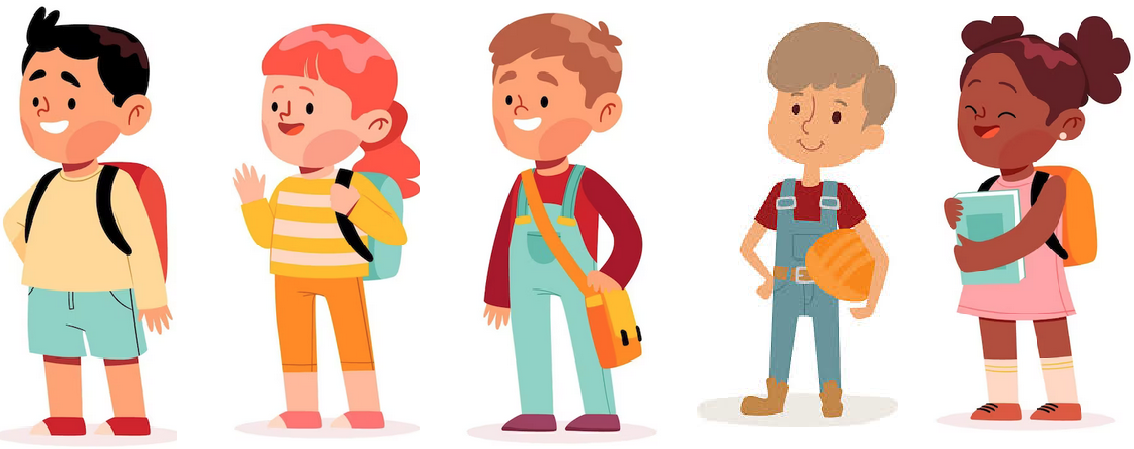
We have 5 groups, and each group has 2 eyes. We can skip-count by 2s: 2, 4, 6, 8, 10.
This is the same as the multiplication sentence: \(5 \times 2 = 10\).
A smart trick is to remember that \(5 \times 2\) is the same as \(2 \times 5\). This can be easier to calculate: \(5 + 5 = 10\).


Proposition Times Table of 2
\(\begin{aligned} \textcolor{colordef}{2}\times \textcolor{colorprop}{0}&=\textcolor{olive}{0}\\\textcolor{colordef}{2}\times \textcolor{colorprop}{1}&=\textcolor{olive}{2}\\ \textcolor{colordef}{2}\times \textcolor{colorprop}{2}&=\textcolor{olive}{4 }\\ \textcolor{colordef}{2}\times \textcolor{colorprop}{3}&=\textcolor{olive}{6 }\\ \textcolor{colordef}{2}\times \textcolor{colorprop}{4}&=\textcolor{olive}{8 }\\ \textcolor{colordef}{2}\times \textcolor{colorprop}{5}&=\textcolor{olive}{10 }\\ \textcolor{colordef}{2}\times \textcolor{colorprop}{6}&=\textcolor{olive}{12 }\\ \textcolor{colordef}{2}\times \textcolor{colorprop}{7}&=\textcolor{olive}{14 }\\ \textcolor{colordef}{2}\times \textcolor{colorprop}{8}&=\textcolor{olive}{16 }\\ \textcolor{colordef}{2}\times \textcolor{colorprop}{9}&=\textcolor{olive}{18 }\\ \textcolor{colordef}{2}\times \textcolor{colorprop}{10}&=\textcolor{olive}{20}\end{aligned}\) \(\quad \quad\) \(\begin{aligned}\textcolor{colordef}{0}\times \textcolor{colorprop}{2}&=\textcolor{olive}{0}\\\textcolor{colordef}{1}\times \textcolor{colorprop}{2}&=\textcolor{olive}{2}\\\textcolor{colordef}{2}\times \textcolor{colorprop}{2}&=\textcolor{olive}{4 }\\\textcolor{colordef}{3}\times \textcolor{colorprop}{2}&=\textcolor{olive}{6 }\\\textcolor{colordef}{4}\times \textcolor{colorprop}{2}&=\textcolor{olive}{8 }\\\textcolor{colordef}{5}\times \textcolor{colorprop}{2}&=\textcolor{olive}{10 }\\\textcolor{colordef}{6}\times \textcolor{colorprop}{2}&=\textcolor{olive}{12 }\\\textcolor{colordef}{7}\times \textcolor{colorprop}{2}&=\textcolor{olive}{14 }\\\textcolor{colordef}{8}\times \textcolor{colorprop}{2}&=\textcolor{olive}{16 }\\\textcolor{colordef}{9}\times \textcolor{colorprop}{2}&=\textcolor{olive}{18 }\\\textcolor{colordef}{10}\times \textcolor{colorprop}{2}&=\textcolor{olive}{20}\end{aligned}\)

The 5s Times Table


How many cubes are there in total?
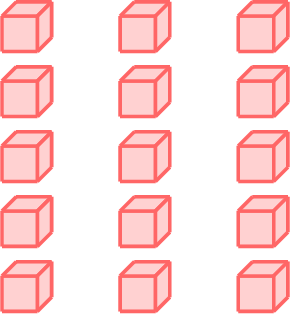
We see 3 groups of 5. We can skip-count by 5s: 5, 10, 15.

There are \(3 \times 5 = 5 + 5 + 5 = 15\) cubes.


Proposition Times Table of 5
\(\begin{aligned}\textcolor{colordef}{5}\times \textcolor{colorprop}{0}&=\textcolor{olive}{0}\\\textcolor{colordef}{5}\times \textcolor{colorprop}{1}&=\textcolor{olive}{5}\\\textcolor{colordef}{5}\times \textcolor{colorprop}{2}&=\textcolor{olive}{10 }\\\textcolor{colordef}{5}\times \textcolor{colorprop}{3}&=\textcolor{olive}{15 }\\\textcolor{colordef}{5}\times \textcolor{colorprop}{4}&=\textcolor{olive}{20 }\\\textcolor{colordef}{5}\times \textcolor{colorprop}{5}&=\textcolor{olive}{25 }\\\textcolor{colordef}{5}\times \textcolor{colorprop}{6}&=\textcolor{olive}{30 }\\\textcolor{colordef}{5}\times \textcolor{colorprop}{7}&=\textcolor{olive}{35 }\\\textcolor{colordef}{5}\times \textcolor{colorprop}{8}&=\textcolor{olive}{40 }\\\textcolor{colordef}{5}\times \textcolor{colorprop}{9}&=\textcolor{olive}{45 }\\\textcolor{colordef}{5}\times \textcolor{colorprop}{10}&=\textcolor{olive}{50}\end{aligned}\) \(\quad \quad\) \(\begin{aligned}\textcolor{colordef}{0}\times \textcolor{colorprop}{5}&=\textcolor{olive}{0}\\\textcolor{colordef}{1}\times \textcolor{colorprop}{5}&=\textcolor{olive}{5}\\\textcolor{colordef}{2}\times \textcolor{colorprop}{5}&=\textcolor{olive}{10}\\\textcolor{colordef}{3}\times \textcolor{colorprop}{5}&=\textcolor{olive}{15}\\\textcolor{colordef}{4}\times \textcolor{colorprop}{5}&=\textcolor{olive}{20}\\\textcolor{colordef}{5}\times \textcolor{colorprop}{5}&=\textcolor{olive}{25}\\\textcolor{colordef}{6}\times \textcolor{colorprop}{5}&=\textcolor{olive}{30}\\\textcolor{colordef}{7}\times \textcolor{colorprop}{5}&=\textcolor{olive}{35}\\\textcolor{colordef}{8}\times \textcolor{colorprop}{5}&=\textcolor{olive}{40}\\\textcolor{colordef}{9}\times \textcolor{colorprop}{5}&=\textcolor{olive}{45}\\\textcolor{colordef}{10}\times \textcolor{colorprop}{5}&=\textcolor{olive}{50}\end{aligned}\)

The 10s Times Table


How many cubes are in these 3 groups of 10?
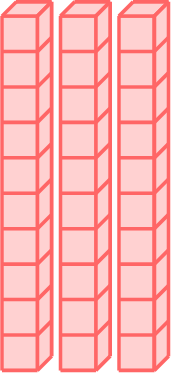
We have 3 groups of 10. We can skip-count by 10s: 10, 20, 30.
There are \(3 \times 10 = 10 + 10 + 10 = 30\) cubes.


Proposition Times Table of 10
\(\begin{aligned}\textcolor{colordef}{10} \times \textcolor{colorprop}{0} &= \textcolor{olive}{0} \\\textcolor{colordef}{10} \times \textcolor{colorprop}{1} &= \textcolor{olive}{10} \\\textcolor{colordef}{10} \times \textcolor{colorprop}{2} &= \textcolor{olive}{20} \\\textcolor{colordef}{10} \times \textcolor{colorprop}{3} &= \textcolor{olive}{30} \\\textcolor{colordef}{10} \times \textcolor{colorprop}{4} &= \textcolor{olive}{40} \\\textcolor{colordef}{10} \times \textcolor{colorprop}{5} &= \textcolor{olive}{50} \\\textcolor{colordef}{10} \times \textcolor{colorprop}{6} &= \textcolor{olive}{60} \\\textcolor{colordef}{10} \times \textcolor{colorprop}{7} &= \textcolor{olive}{70} \\\textcolor{colordef}{10} \times \textcolor{colorprop}{8} &= \textcolor{olive}{80} \\\textcolor{colordef}{10} \times \textcolor{colorprop}{9} &= \textcolor{olive}{90} \\\textcolor{colordef}{10} \times \textcolor{colorprop}{10} &= \textcolor{olive}{100}\end{aligned}\) \(\quad \quad\) \(\begin{aligned}\textcolor{colordef}{0} \times \textcolor{colorprop}{10} &= \textcolor{olive}{0} \\\textcolor{colordef}{1} \times \textcolor{colorprop}{10} &= \textcolor{olive}{10} \\\textcolor{colordef}{2} \times \textcolor{colorprop}{10} &= \textcolor{olive}{20} \\\textcolor{colordef}{3} \times \textcolor{colorprop}{10} &= \textcolor{olive}{30} \\\textcolor{colordef}{4} \times \textcolor{colorprop}{10} &= \textcolor{olive}{40} \\\textcolor{colordef}{5} \times \textcolor{colorprop}{10} &= \textcolor{olive}{50} \\\textcolor{colordef}{6} \times \textcolor{colorprop}{10} &= \textcolor{olive}{60} \\\textcolor{colordef}{7} \times \textcolor{colorprop}{10} &= \textcolor{olive}{70} \\\textcolor{colordef}{8} \times \textcolor{colorprop}{10} &= \textcolor{olive}{80} \\\textcolor{colordef}{9} \times \textcolor{colorprop}{10} &= \textcolor{olive}{90} \\\textcolor{colordef}{10} \times \textcolor{colorprop}{10} &= \textcolor{olive}{100}\end{aligned}\)

The 3s Times Table


Each bunch has 3 bananas. How many bananas are there altogether?
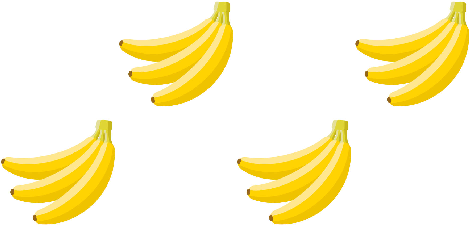
We have 4 groups of 3. We can skip-count by 3s: 3, 6, 9, 12.

There are \(4 \times 3 = 3 + 3 + 3 + 3 = 12\) bananas.


Proposition Times Table of 3
\(\begin{aligned}\textcolor{colordef}{3}\times \textcolor{colorprop}{0}&=\textcolor{olive}{0}\\\textcolor{colordef}{3}\times \textcolor{colorprop}{1}&=\textcolor{olive}{3}\\\textcolor{colordef}{3}\times \textcolor{colorprop}{2}&=\textcolor{olive}{6 }\\\textcolor{colordef}{3}\times \textcolor{colorprop}{3}&=\textcolor{olive}{9 }\\\textcolor{colordef}{3}\times \textcolor{colorprop}{4}&=\textcolor{olive}{12 }\\\textcolor{colordef}{3}\times \textcolor{colorprop}{5}&=\textcolor{olive}{15 }\\\textcolor{colordef}{3}\times \textcolor{colorprop}{6}&=\textcolor{olive}{18 }\\\textcolor{colordef}{3}\times \textcolor{colorprop}{7}&=\textcolor{olive}{21 }\\\textcolor{colordef}{3}\times \textcolor{colorprop}{8}&=\textcolor{olive}{24 }\\\textcolor{colordef}{3}\times \textcolor{colorprop}{9}&=\textcolor{olive}{27 }\\\textcolor{colordef}{3}\times \textcolor{colorprop}{10}&=\textcolor{olive}{30}\end{aligned}\) \(\quad \quad\) \(\begin{aligned}\textcolor{colordef}{0}\times \textcolor{colorprop}{3}&=\textcolor{olive}{0}\\\textcolor{colordef}{1}\times \textcolor{colorprop}{3}&=\textcolor{olive}{3}\\\textcolor{colordef}{2}\times \textcolor{colorprop}{3}&=\textcolor{olive}{6}\\\textcolor{colordef}{3}\times \textcolor{colorprop}{3}&=\textcolor{olive}{9}\\\textcolor{colordef}{4}\times \textcolor{colorprop}{3}&=\textcolor{olive}{12}\\\textcolor{colordef}{5}\times \textcolor{colorprop}{3}&=\textcolor{olive}{15}\\\textcolor{colordef}{6}\times \textcolor{colorprop}{3}&=\textcolor{olive}{18}\\\textcolor{colordef}{7}\times \textcolor{colorprop}{3}&=\textcolor{olive}{21}\\\textcolor{colordef}{8}\times \textcolor{colorprop}{3}&=\textcolor{olive}{24}\\\textcolor{colordef}{9}\times \textcolor{colorprop}{3}&=\textcolor{olive}{27}\\\textcolor{colordef}{10}\times \textcolor{colorprop}{3}&=\textcolor{olive}{30}\end{aligned}\)

The 4s Times Table


If each butterfly has 4 wings, how many wings are there in total?
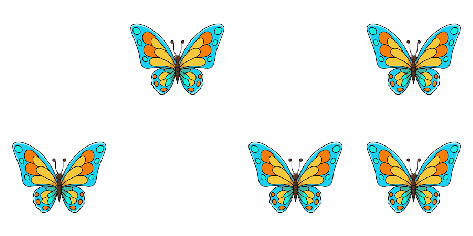
There are 5 groups of 4. We can skip-count by 4s: 4, 8, 12, 16, 20.

There are \(5 \times 4 = 4 + 4 + 4 + 4 + 4 = 20\) wings.


Proposition Times Table of 4
\(\begin{aligned}\textcolor{colordef}{4}\times \textcolor{colorprop}{0}&=\textcolor{olive}{0}\\\textcolor{colordef}{4}\times \textcolor{colorprop}{1}&=\textcolor{olive}{4}\\\textcolor{colordef}{4}\times \textcolor{colorprop}{2}&=\textcolor{olive}{8 }\\\textcolor{colordef}{4}\times \textcolor{colorprop}{3}&=\textcolor{olive}{12 }\\\textcolor{colordef}{4}\times \textcolor{colorprop}{4}&=\textcolor{olive}{16 }\\\textcolor{colordef}{4}\times \textcolor{colorprop}{5}&=\textcolor{olive}{20 }\\\textcolor{colordef}{4}\times \textcolor{colorprop}{6}&=\textcolor{olive}{24 }\\\textcolor{colordef}{4}\times \textcolor{colorprop}{7}&=\textcolor{olive}{28 }\\\textcolor{colordef}{4}\times \textcolor{colorprop}{8}&=\textcolor{olive}{32 }\\\textcolor{colordef}{4}\times \textcolor{colorprop}{9}&=\textcolor{olive}{36 }\\\textcolor{colordef}{4}\times \textcolor{colorprop}{10}&=\textcolor{olive}{40}\end{aligned}\) \(\quad \quad\) \(\begin{aligned}\textcolor{colordef}{0}\times \textcolor{colorprop}{4}&=\textcolor{olive}{0}\\\textcolor{colordef}{1}\times \textcolor{colorprop}{4}&=\textcolor{olive}{4}\\\textcolor{colordef}{2}\times \textcolor{colorprop}{4}&=\textcolor{olive}{8}\\\textcolor{colordef}{3}\times \textcolor{colorprop}{4}&=\textcolor{olive}{12}\\\textcolor{colordef}{4}\times \textcolor{colorprop}{4}&=\textcolor{olive}{16}\\\textcolor{colordef}{5}\times \textcolor{colorprop}{4}&=\textcolor{olive}{20}\\\textcolor{colordef}{6}\times \textcolor{colorprop}{4}&=\textcolor{olive}{24}\\\textcolor{colordef}{7}\times \textcolor{colorprop}{4}&=\textcolor{olive}{28}\\\textcolor{colordef}{8}\times \textcolor{colorprop}{4}&=\textcolor{olive}{32}\\\textcolor{colordef}{9}\times \textcolor{colorprop}{4}&=\textcolor{olive}{36}\\\textcolor{colordef}{10}\times \textcolor{colorprop}{4}&=\textcolor{olive}{40}\end{aligned}\)