Lengths
Comparing Lengths
Method Line Up to Compare Lengths
To compare two objects, we can check which is longer or shorter.
Lay them side by side and carefully line up one end on the same line. The object that goes further is longer. The other is shorter.
If we stand them up, the one that is higher is taller. The other is shorter.
Lay them side by side and carefully line up one end on the same line. The object that goes further is longer. The other is shorter.
If we stand them up, the one that is higher is taller. The other is shorter.
Example

The girl is taller than the boy.
The boy is shorter than the girl.
Measuring Lengths
Method Measuring with Units
To measure how long an object is, we can use smaller items like paper clips, blocks, or erasers.
Use the same kind of item for the whole measurement. Line them up in a straight line right next to the object. Make sure there are no gaps between them. Then, count how many you used.
Use the same kind of item for the whole measurement. Line them up in a straight line right next to the object. Make sure there are no gaps between them. Then, count how many you used.
Example
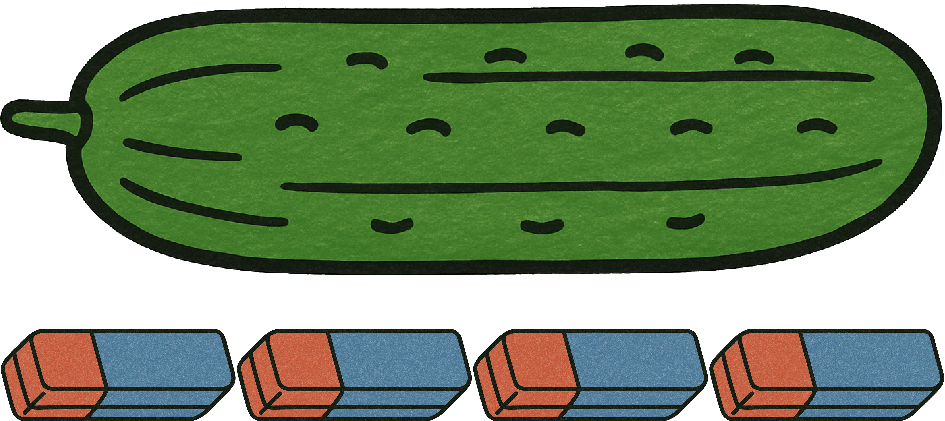
The cucumber is 4 erasers long.
Units of Length
We can measure length in many ways, for example with our footsteps or with paper clips. But everyone's footsteps and paper clips are different sizes! How can we share our measurements if we all use different units?
To solve this, people all around the world agreed to use the same units. We call these standard units. One very common standard unit for length is the meter.
To solve this, people all around the world agreed to use the same units. We call these standard units. One very common standard unit for length is the meter.
Definition Units of Length
- Centimeter \(\left(\mathrm{cm}\right)\): a small unit of length, about the width of your finger.

- Meter \(\left(\mathrm{m}\right)\): a longer unit of length, about the height of a 6-year-old girl.