Angles
What is an Angle?
Comparing Angles
Mcq
Which angle has the greater measure?
The measure of an angle depends on the opening between its rays. A wider opening means a greater angle measure. Angle B has a wider opening (\(120^\circ\)) compared to Angle A (\(30^\circ\)). Therefore, Angle B is greater.
Mcq
Which angle has the greater measure?
The measure of an angle depends on the opening between its rays. A wider opening means a greater angle measure. Angle B has a wider opening (\(100^\circ\)) compared to Angle A (\(30^\circ\)). Therefore, Angle B is greater.
Mcq
Which angle has the greater measure?
The measure of an angle depends on the opening between its rays. A wider opening means a greater angle measure. Angle A has a wider opening (\(170^\circ\)) compared to Angle B (\(80^\circ\)). Therefore, Angle A is greater.
Mcq
Which angle has the greater measure?
The measure of an angle depends on the opening between its rays. A wider opening means a greater angle measure. Angle A has a wider opening (\(60^\circ\)) compared to Angle B (\(30^\circ\)). Therefore, Angle A is greater.
Mcq
Which angle has the greater measure?
The measure of an angle depends on the opening between its rays. A wider opening means a greater angle measure. Angle A has a wider opening (\(90^\circ\)) compared to Angle B (\(30^\circ\)). Therefore, Angle A is greater.
Naming Angles with Three Points
Mcq
Which option correctly names the marked angle using three-point notation?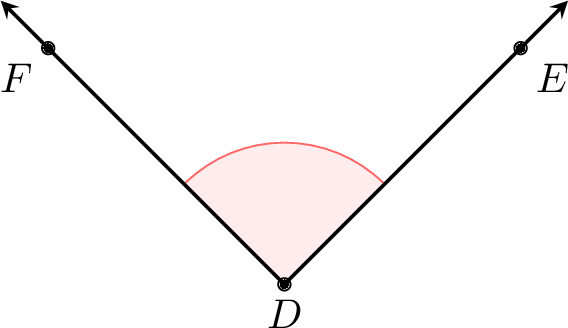
The marked angle has vertex \(D\), with points \(E\) and \(F\) on its sides. In three-point notation, the vertex is in the middle, so the correct name is \(\Angle{FDE}\).
Mcq
Which option correctly names the marked angle using three-point notation?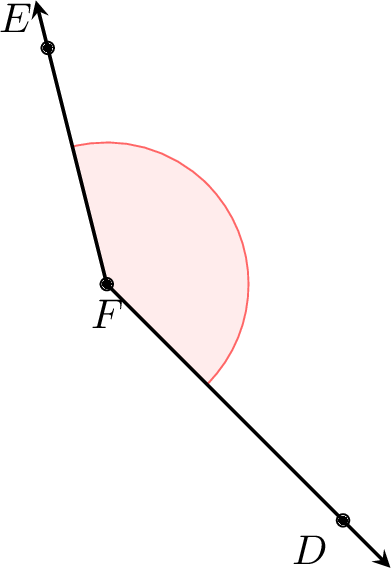
The marked angle has vertex \(F\), with points \(D\) and \(E\) on its sides. In three-point notation, the vertex is in the middle, so the correct name is \(\Angle{DFE}\).
Mcq
Which option correctly names the marked angle using three-point notation?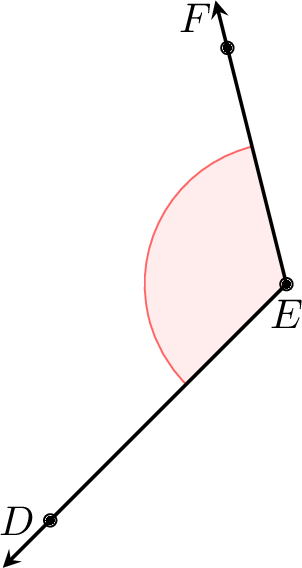
The marked angle has vertex \(E\), with points \(D\) and \(F\) on its sides. In three-point notation, the vertex is in the middle, so the correct name is \(\Angle{DEF}\).
Mcq
Which option correctly names the marked angle using three-point notation?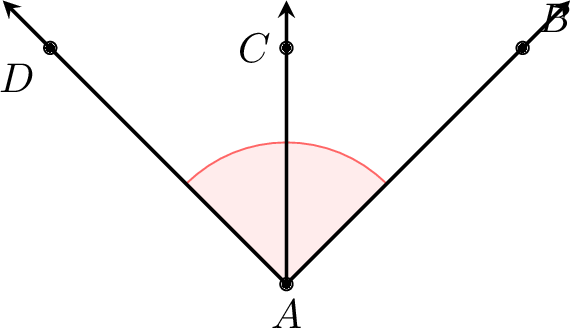
The marked angle has vertex \(A\), with points \(D\) and \(B\) on its sides. In three-point notation, the vertex is in the middle, so the correct name is \(\Angle{DAB}\).
Mcq
Which option correctly names the marked angle using three-point notation?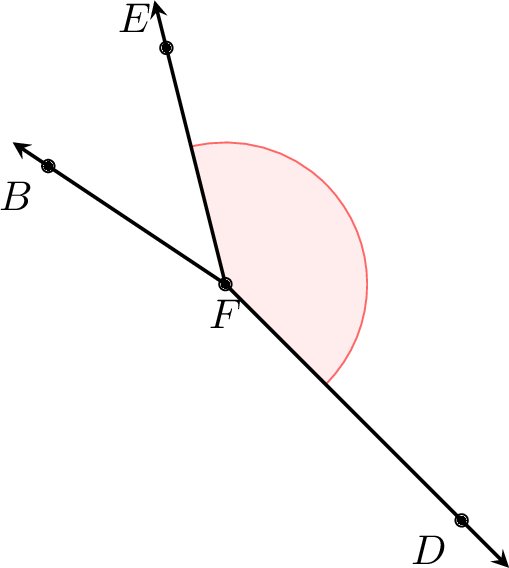
The marked angle has vertex \(F\), with points \(D\) and \(E\) on its sides. In three-point notation, the vertex is in the middle, so the correct name is \(\Angle{DFE}\).
Mcq
Which option correctly names the marked angle using three-point notation?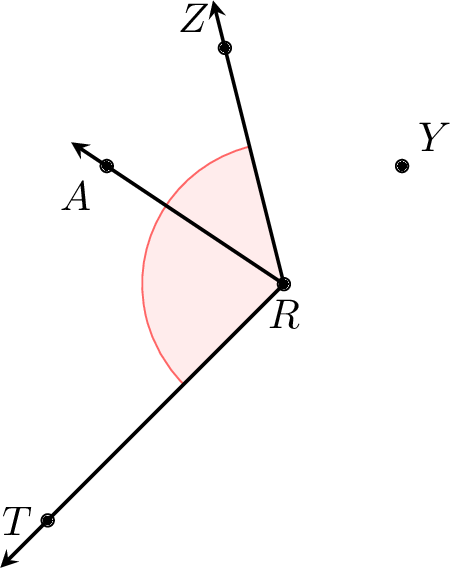
The marked angle has vertex \(R\), with points \(T\) and \(Z\) on its sides. In three-point notation, the vertex is in the middle, so the correct name is \(\Angle{ZRT}\).
Degrees
Dividing the Full Turn
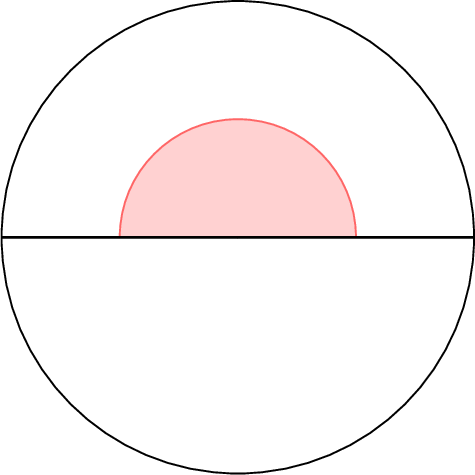
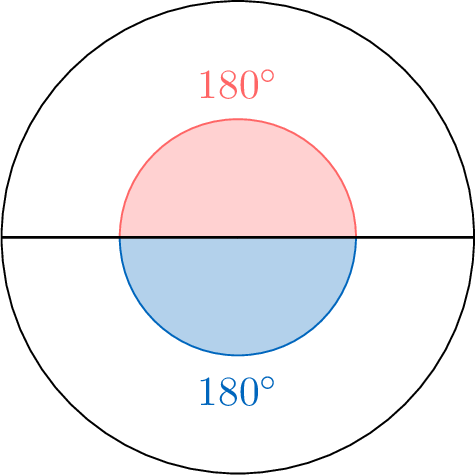
$$\begin{aligned}\text{One-half of a full turn} &= \frac{1}{2} \times 360^\circ \\
&= 360^\circ \div 2 \\
&= 180^\circ\end{aligned}$$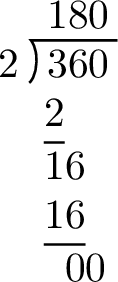
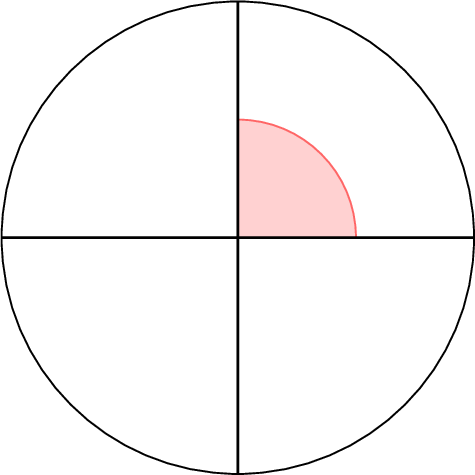
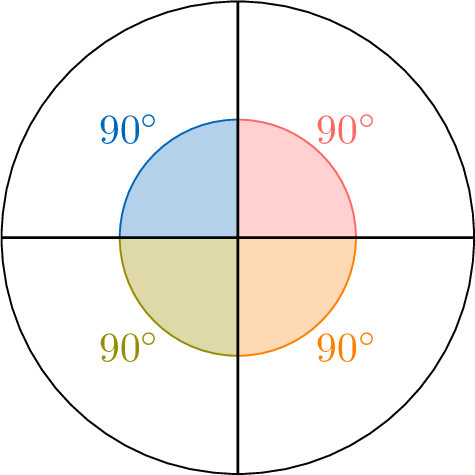
$$\begin{aligned}\text{One-quarter of a full turn} &= \frac{1}{4} \times 360^\circ \\
&= 360^\circ \div 4 \\
&= 90^\circ\end{aligned}$$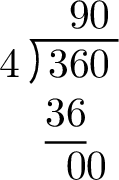
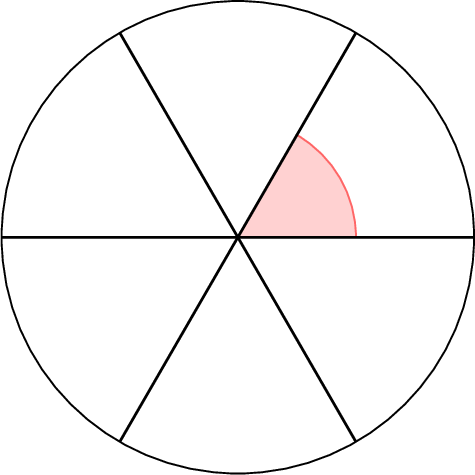
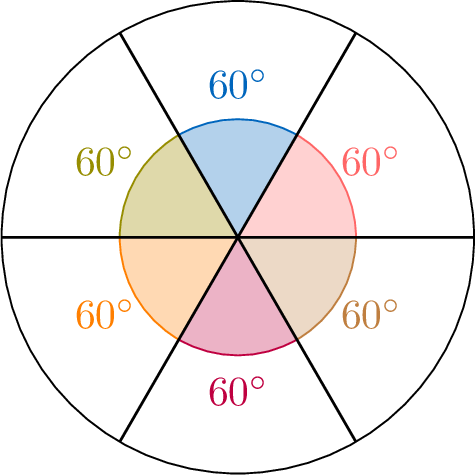
$$\begin{aligned}\text{One-sixth of a full turn} &= \frac{1}{6} \times 360^\circ \\
&= 360^\circ \div 6 \\
&= 60^\circ\end{aligned}$$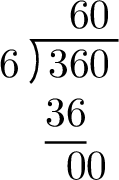
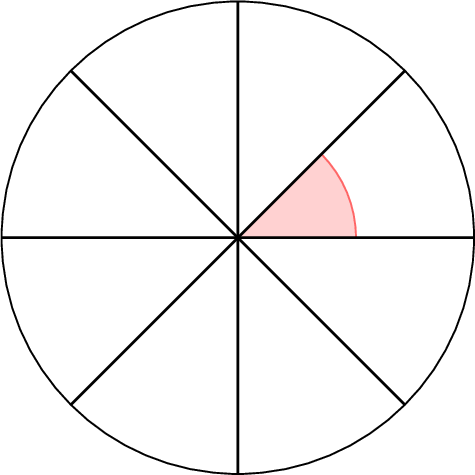
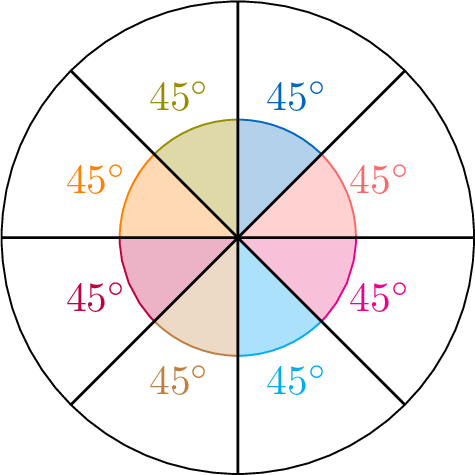
$$\begin{aligned}\text{One-eighth of a full turn} &= \frac{1}{8} \times 360^\circ \\
&= 360^\circ \div 8 \\
&= 45^\circ\end{aligned}$$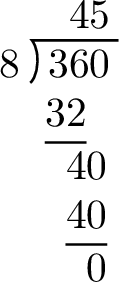
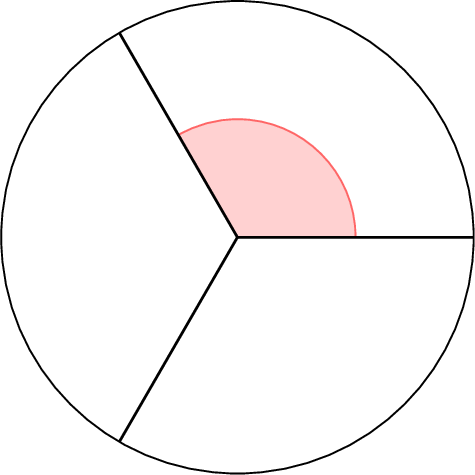
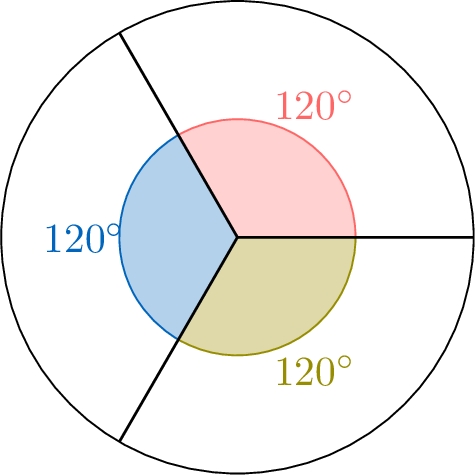
$$\begin{aligned}\text{One-third of a full turn} &= \frac{1}{3} \times 360^\circ \\
&= 360^\circ \div 3 \\
&= 120^\circ\end{aligned}$$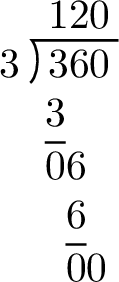
Measuring and Drawing Angles with a Protractor
Measuring Angles
Exercise
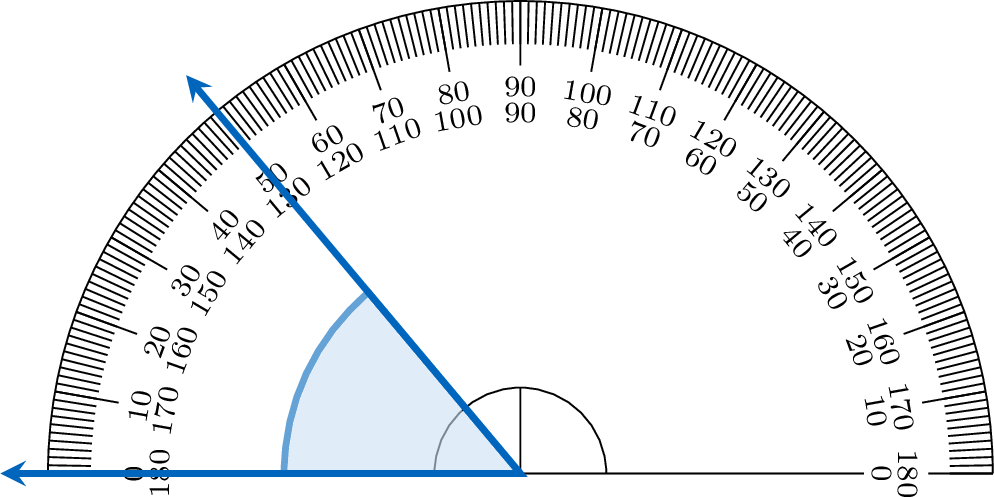
To measure an angle with a protractor, place its center on the vertex and align one ray with the \(0^\circ\) mark. The other ray points to the angle’s measure on the protractor’s scale. Here, one ray aligns with \(0^\circ\), and the other points to \(50^\circ\), so the angle measures \(50^\circ\).
Exercise
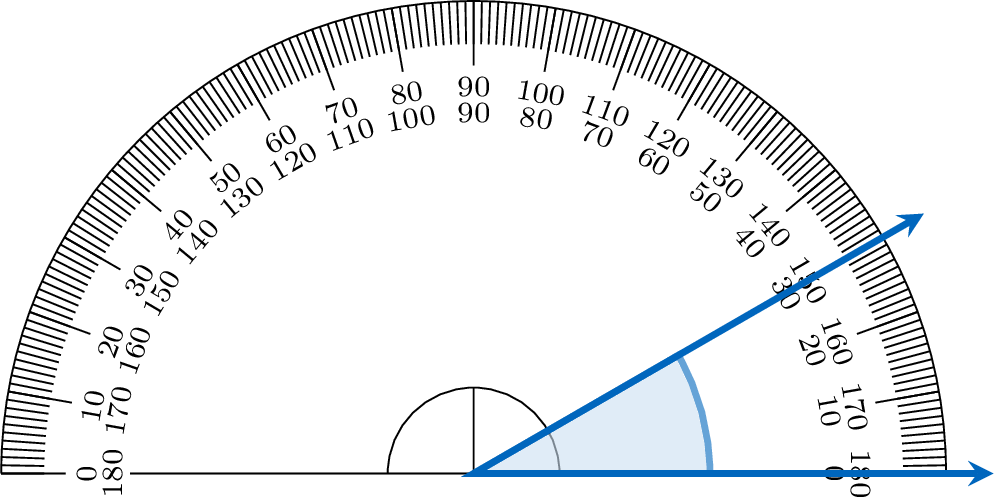
To measure an angle with a protractor, place its center on the vertex and align one ray with the \(0^\circ\) mark. The other ray points to the angle’s measure on the protractor’s scale. Here, one ray aligns with \(0^\circ\), and the other points to \(30^\circ\), so the angle measures \(30^\circ\).
Exercise

To measure an angle with a protractor, place its center on the vertex and align one ray with the \(0^\circ\) mark. The other ray points to the angle’s measure on the protractor’s scale. Here, one ray aligns with \(0^\circ\), and the other points to \(100^\circ\), so the angle measures \(100^\circ\).
Exercise
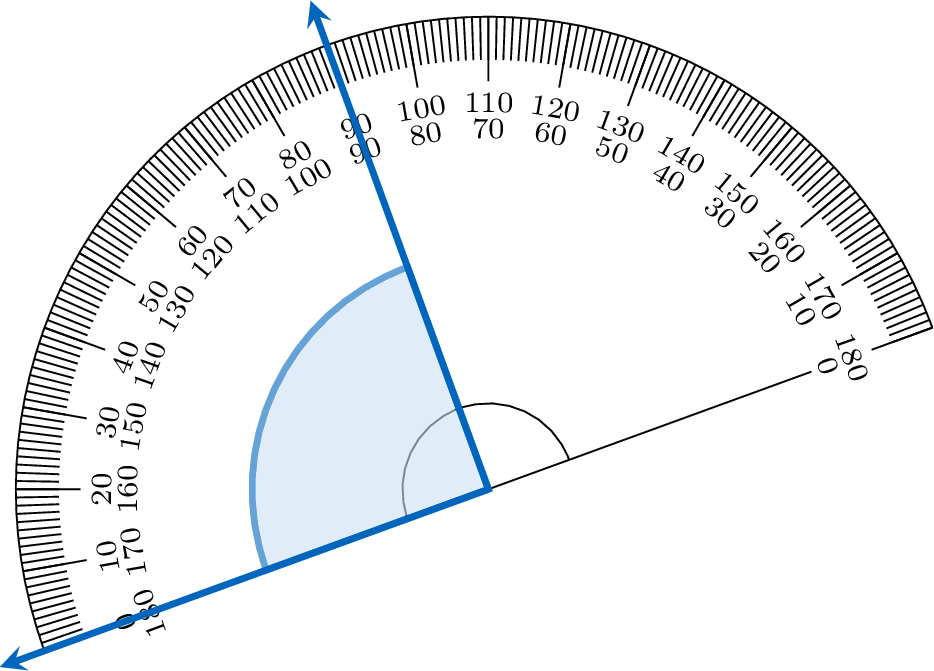
To measure an angle with a protractor, place its center on the vertex and align one ray with the \(0^\circ\) mark. The other ray points to the angle’s measure on the protractor’s scale. Here, one ray aligns with \(0^\circ\), and the other points to \(90^\circ\), so the angle measures \(90^\circ\).
Exercise
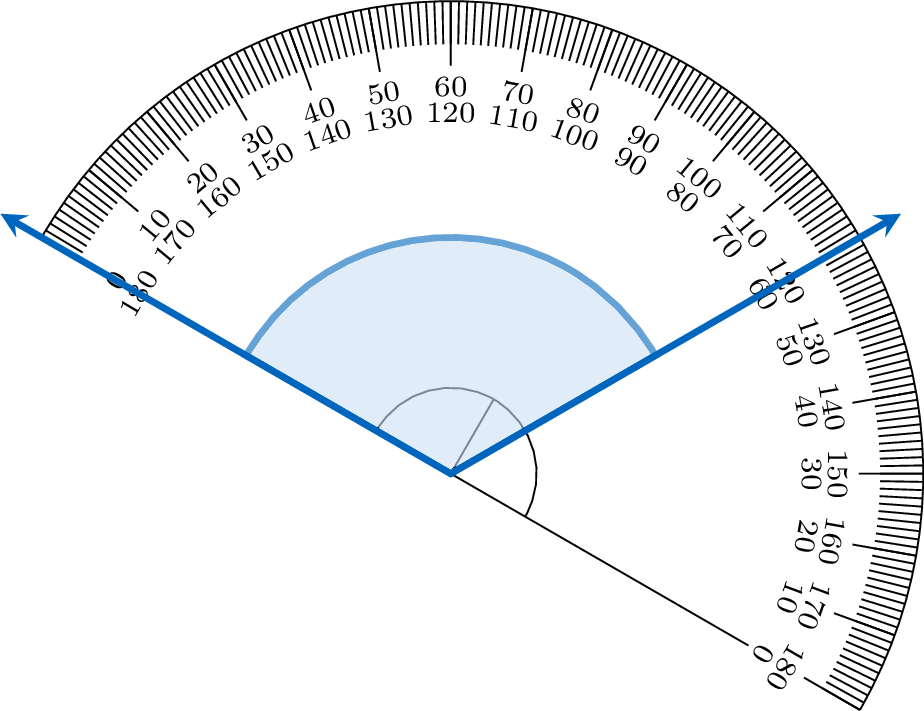
To measure an angle with a protractor, place its center on the vertex and align one ray with the \(0^\circ\) mark. The other ray points to the angle’s measure on the protractor’s scale. Here, one ray aligns with \(0^\circ\), and the other points to \(120^\circ\), so the angle measures \(120^\circ\).
Exercise
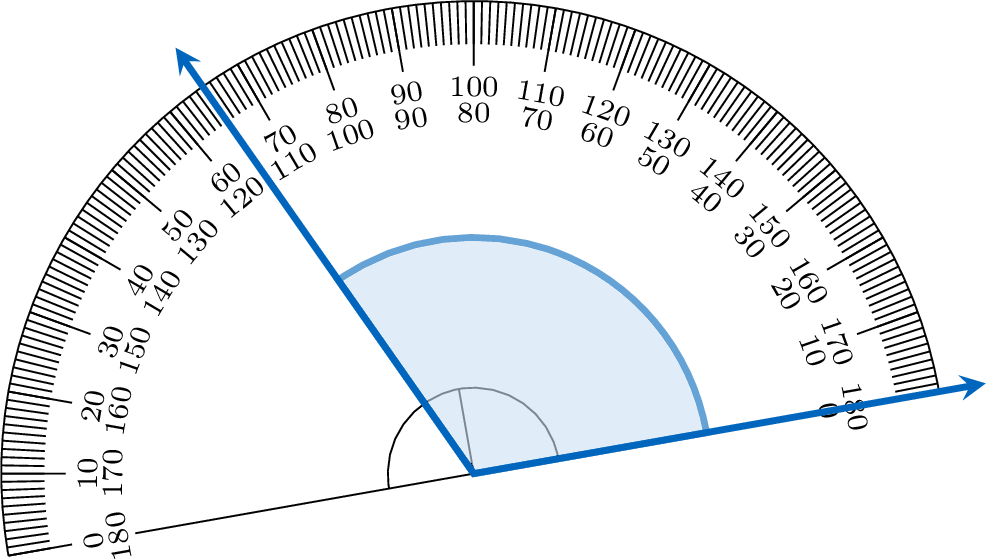
To measure an angle with a protractor, place its center on the vertex and align one ray with the \(0^\circ\) mark. The other ray points to the angle’s measure on the protractor’s scale. Here, one ray aligns with \(0^\circ\), and the other points to \(115^\circ\), so the angle measures \(115^\circ\).
Exercise
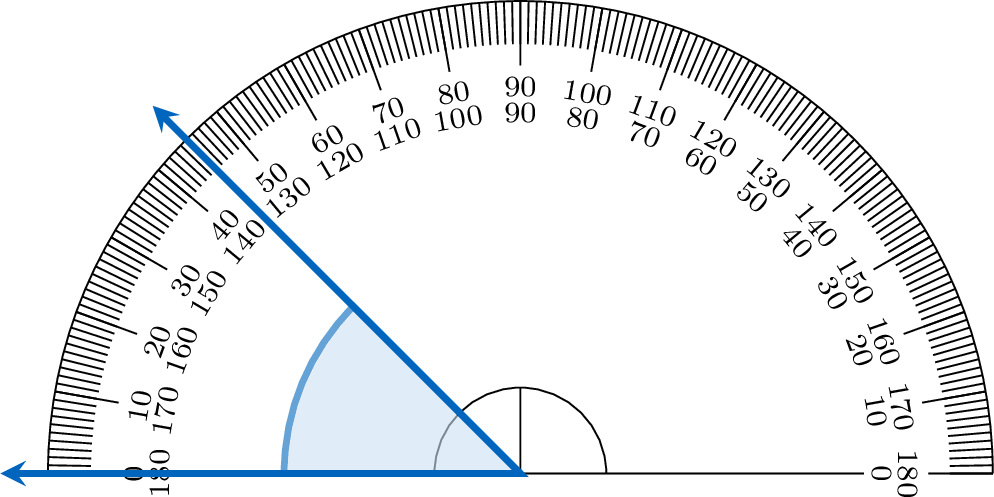
To measure an angle with a protractor, place its center on the vertex and align one ray with the \(0^\circ\) mark. The other ray points to the angle’s measure on the protractor’s scale. Here, one ray aligns with \(0^\circ\), and the other points to \(45^\circ\), so the angle measures \(45^\circ\).
Measuring Angles
Mcq
Using a protractor, find the measure of the angle shown.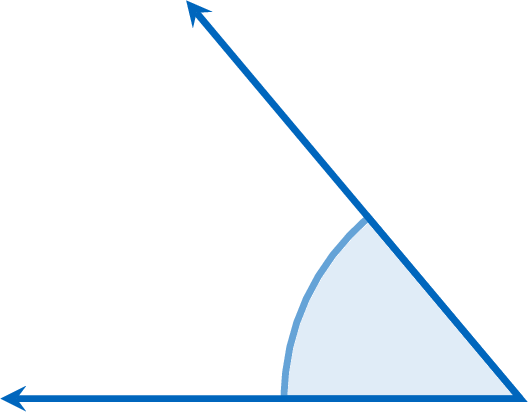
To measure an angle with a protractor, place its center on the vertex and align one ray with the \(0^\circ\) mark. The other ray points to the angle’s measure on the protractor’s scale.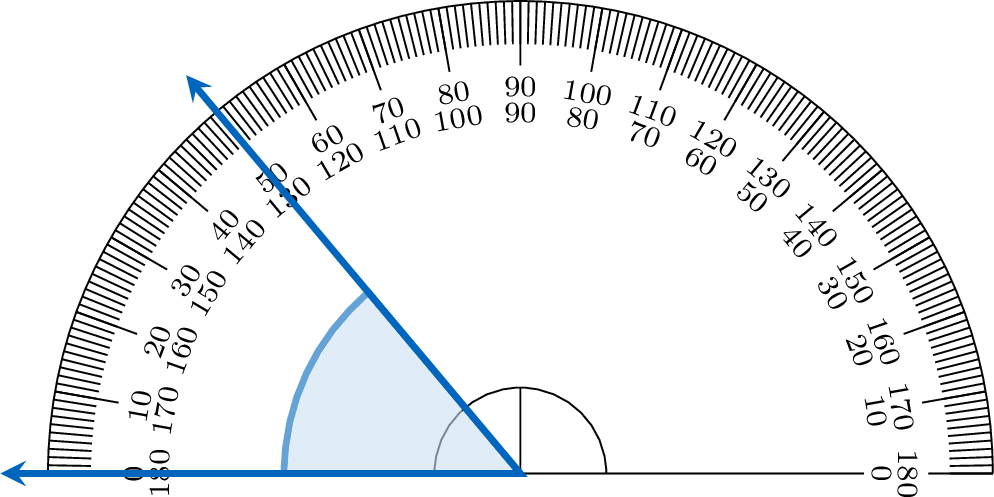
Mcq
Using a protractor, find the measure of the angle shown.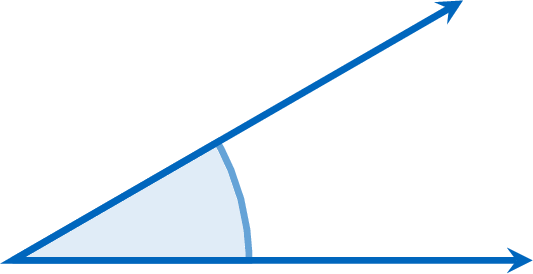
To measure an angle with a protractor, place its center on the vertex and align one ray with the \(0^\circ\) mark. The other ray points to the angle’s measure on the protractor’s scale.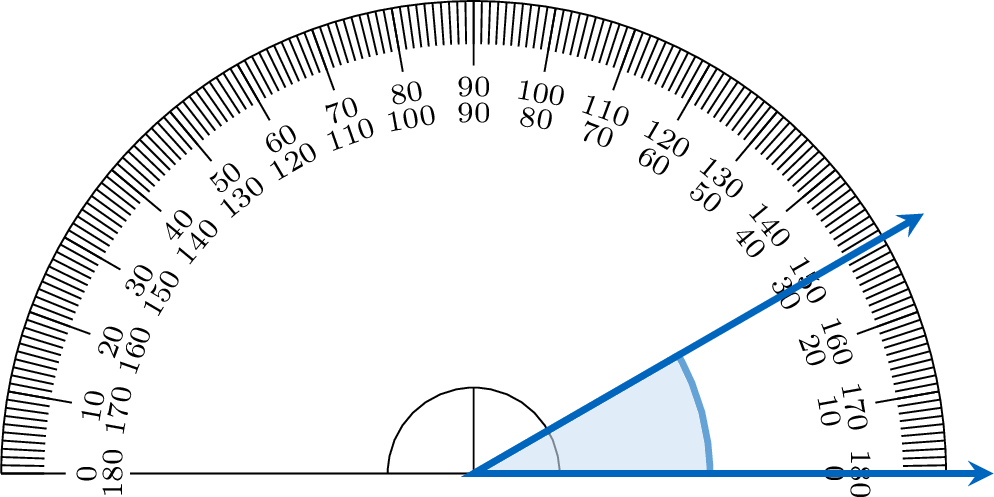
Mcq
Using a protractor, find the measure of the angle shown.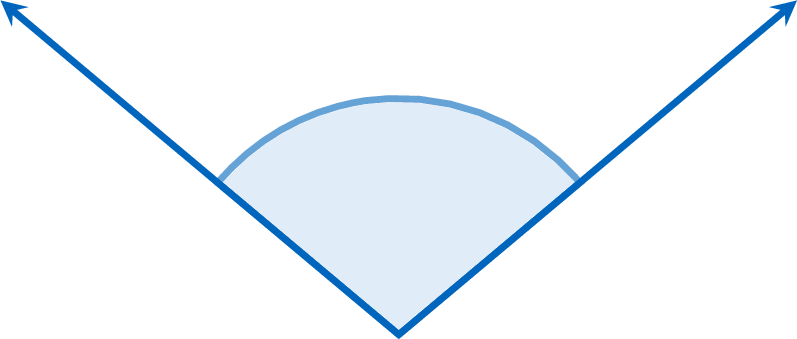
To measure an angle with a protractor, place its center on the vertex and align one ray with the \(0^\circ\) mark. The other ray points to the angle’s measure on the protractor’s scale.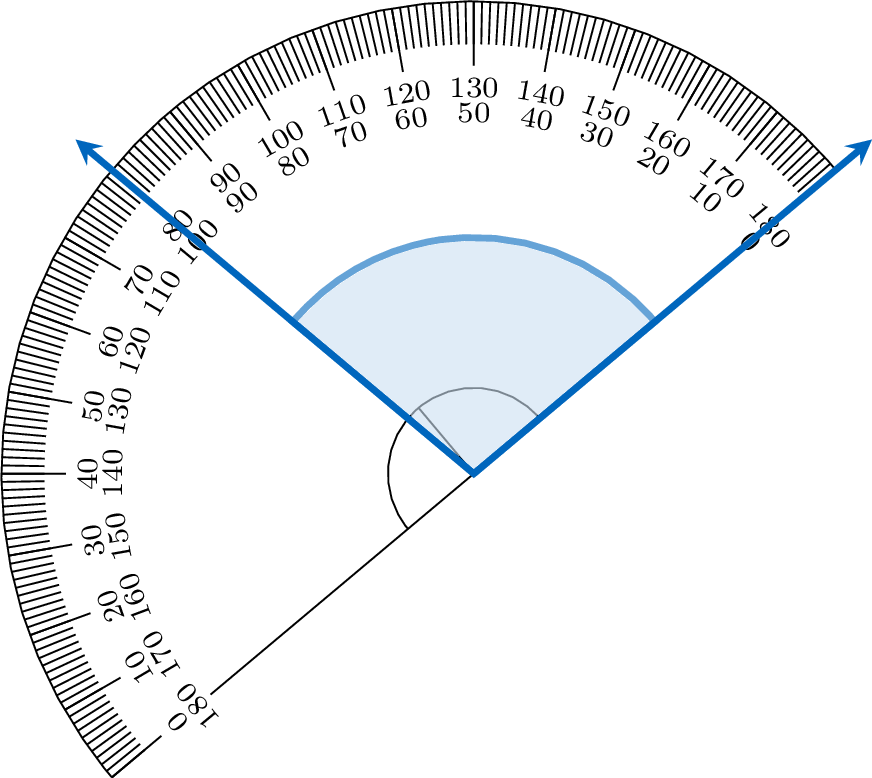
Mcq
Using a protractor, find the measure of the angle shown.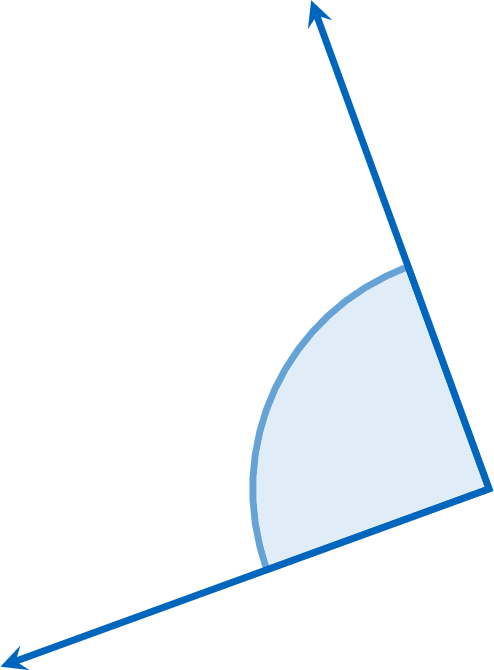
To measure an angle with a protractor, place its center on the vertex and align one ray with the \(0^\circ\) mark. The other ray points to the angle’s measure on the protractor’s scale.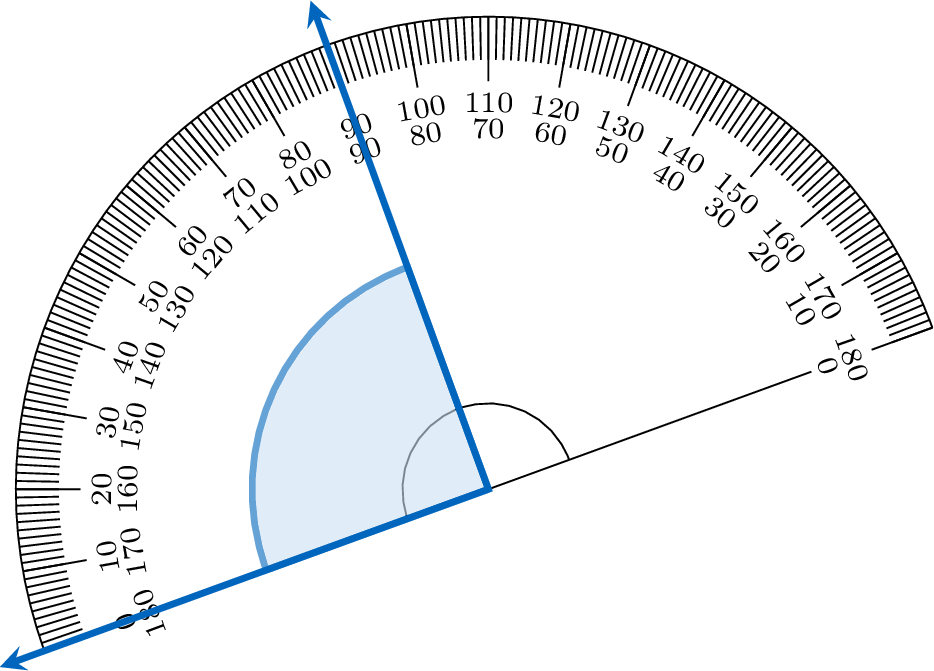
Mcq
Using a protractor, find the measure of the angle shown.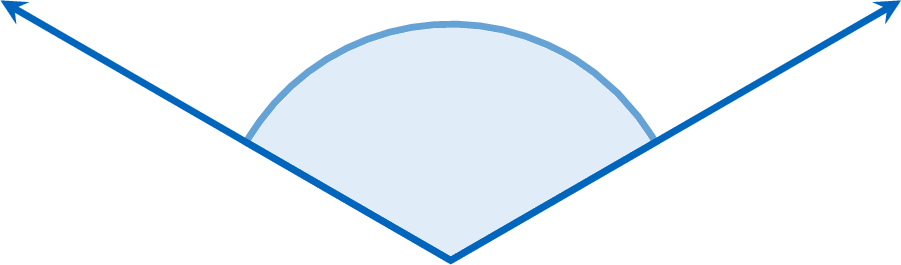
To measure an angle with a protractor, place its center on the vertex and align one ray with the \(0^\circ\) mark. The other ray points to the angle’s measure on the protractor’s scale.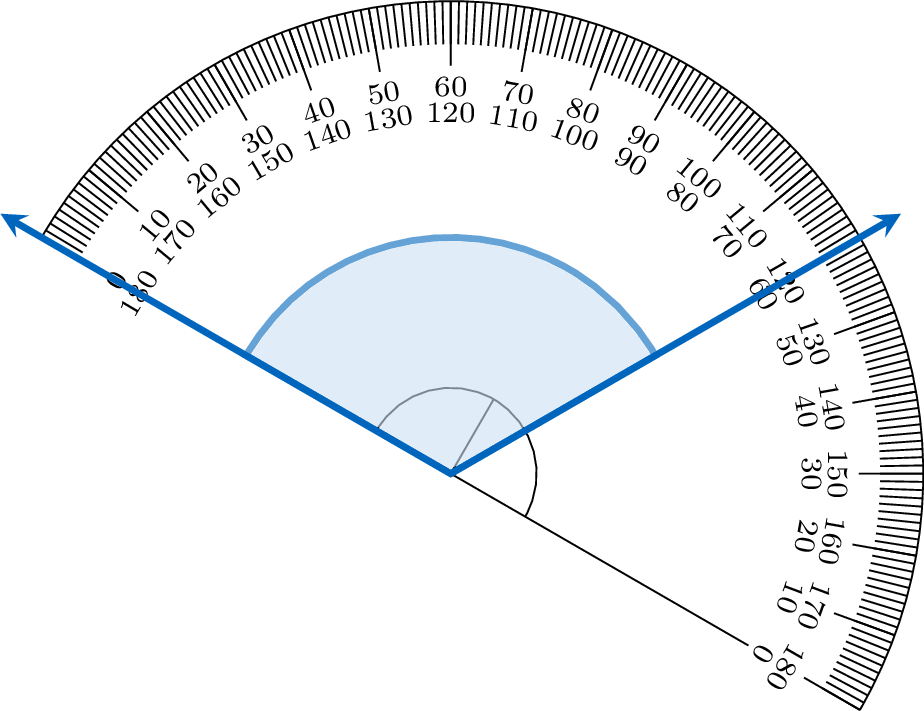
Constructing Angles
Exercise
Using a pencil, a ruler, and a protractor, draw an angle that measures \(90^\circ\).
To draw a \(90^\circ\) angle: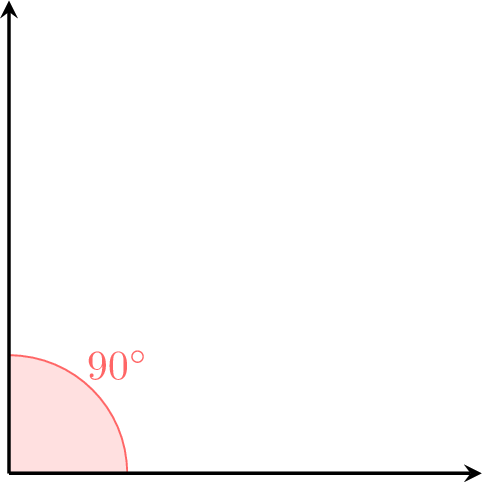
- Draw a ray using a ruler to create the first side of the angle.
- Place the protractor’s center on the endpoint of the ray (the vertex) and align the baseline with the ray at \(0^\circ\).
- Mark a point at \(90^\circ\) on the protractor’s scale.
- Remove the protractor and use the ruler to draw a second ray from the vertex through the marked point.
Exercise
Using a pencil, a ruler, and a protractor, draw an angle that measures \(60^\circ\).
To draw a \(60^\circ\) angle: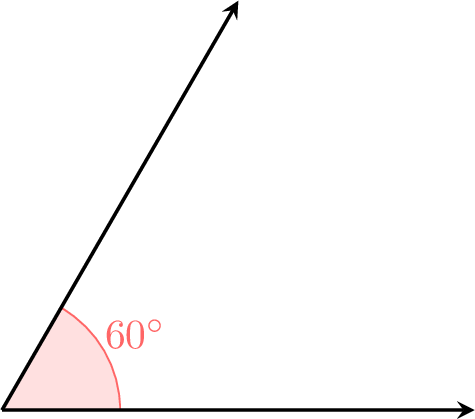
- Draw a ray using a ruler to create the first side of the angle.
- Place the protractor’s center on the endpoint of the ray (the vertex) and align the baseline with the ray at \(0^\circ\).
- Mark a point at \(60^\circ\) on the protractor’s scale.
- Remove the protractor and use the ruler to draw a second ray from the vertex through the marked point.
Exercise
Using a pencil, a ruler, and a protractor, draw an angle that measures \(120^\circ\).
To draw a \(120^\circ\) angle: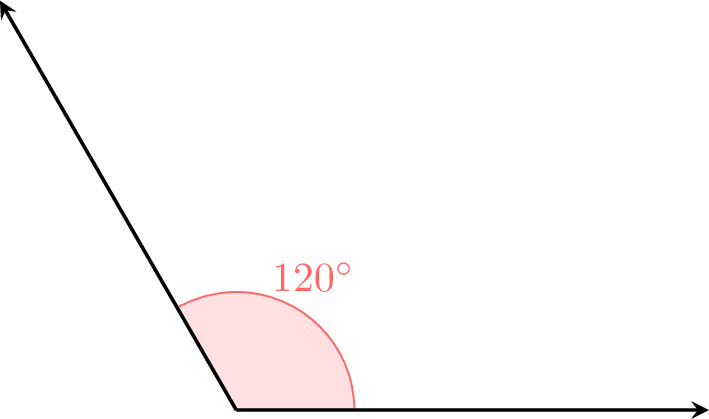
- Draw a ray using a ruler to create the first side of the angle.
- Place the protractor’s center on the endpoint of the ray (the vertex) and align the baseline with the ray at \(0^\circ\).
- Mark a point at \(120^\circ\) on the protractor’s scale.
- Remove the protractor and use the ruler to draw a second ray from the vertex through the marked point.
Exercise
Using a pencil, a ruler, and a protractor, draw an angle that measures \(45^\circ\).
To draw a \(45^\circ\) angle: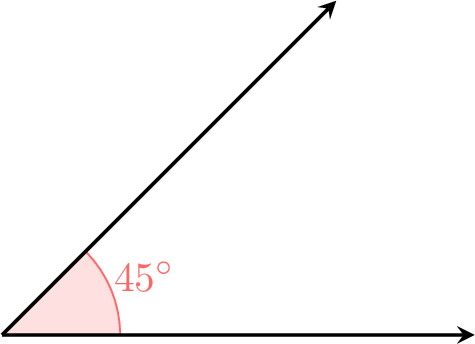
- Draw a ray using a ruler to create the first side of the angle.
- Place the protractor’s center on the endpoint of the ray (the vertex) and align the baseline with the ray at \(0^\circ\).
- Mark a point at \(45^\circ\) on the protractor’s scale.
- Remove the protractor and use the ruler to draw a second ray from the vertex through the marked point.
Classification of Angles
Identifying Angle Types by Measure
Mcq
What is the nature of the marked angle?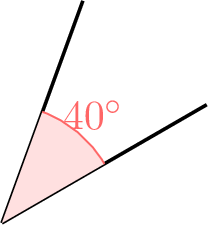
- An acute angle measures less than 90 degrees.
- The marked angle, measuring \(40^\circ\), is acute because it is less than \(90^\circ\).
Mcq
What is the nature of the marked angle?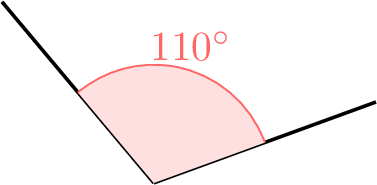
- An obtuse angle measures more than 90 degrees but less than 180 degrees.
- The marked angle, measuring \(110^\circ\), is obtuse because it is between \(90^\circ\) and \(180^\circ\).
Mcq
What is the nature of the marked angle?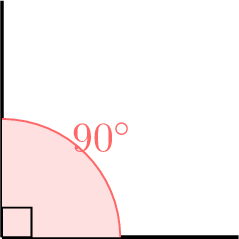
- A right angle measures exactly 90 degrees.
- The marked angle, measuring \(90^\circ\), is a right angle.
Mcq
What is the nature of the marked angle?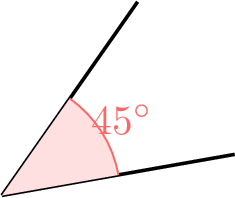
- An acute angle measures less than 90 degrees.
- The marked angle, measuring \(45^\circ\), is acute because it is less than \(90^\circ\).
Mcq
What is the nature of the marked angle?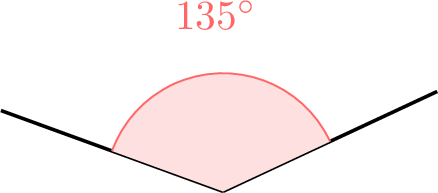
- An obtuse angle measures more than 90 degrees but less than 180 degrees.
- The marked angle, measuring \(135^\circ\), is obtuse because it is between \(90^\circ\) and \(180^\circ\).
Identifying Angle Types
Mcq
Identify the type of the highlighted angle. 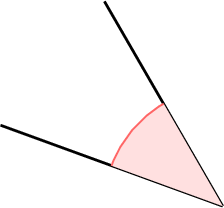
Choose one answer:
- An acute angle measures less than \(90^\circ\).
- The highlighted angle (\(\approx 40^\circ\)) is less open than a right angle
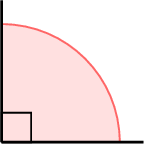 .
. - Hence it is acute.
Mcq
Identify the type of the highlighted angle. 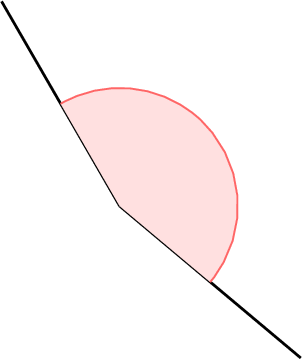
Choose one answer:
- An obtuse angle measures between \(90^\circ\) and \(180^\circ\).
- The highlighted angle (\(\approx160^\circ\)) is more open than a right angle
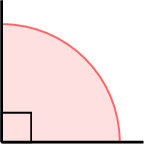 but less than a straight angle
 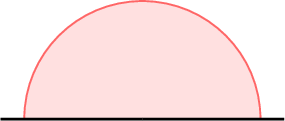 .
. - Therefore it is obtuse.
Mcq
Identify the type of the highlighted angle. 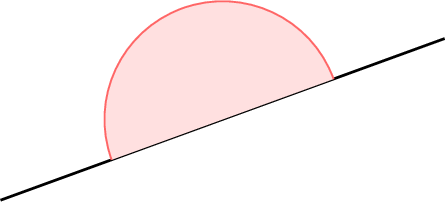
Choose one answer:
- A straight angle measures exactly \(180^\circ\).
- The highlighted angle forms a line.
- It is therefore straight.
Mcq
Identify the type of the highlighted angle. 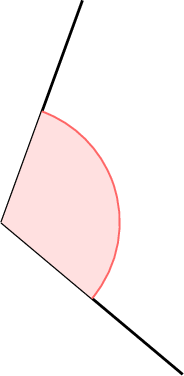
Choose one answer:
- An obtuse angle measures between \(90^\circ\) and \(180^\circ\).
- The highlighted angle (\(\approx110^\circ\)) is more open than a right angle but less open than a straight angle .
- Therefore it is obtuse.
Constructing Angle Types
Exercise
Using a pencil, a ruler, and a protractor, draw an acute angle.
To draw an acute angle, such as a \(40^\circ\) angle: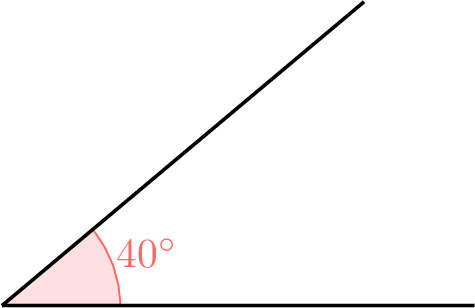
- Draw a ray using a ruler to create the first side of the angle.
- Place the protractor’s center on the endpoint of the ray (the vertex) and align the baseline with the ray at \(0^\circ\).
- Mark a point at \(40^\circ\) on the protractor’s scale (any angle less than \(90^\circ\) is acceptable).
- Remove the protractor and use the ruler to draw a second ray from the vertex through the marked point.
Exercise
Using a pencil, a ruler, and a protractor, draw an obtuse angle.
To draw an obtuse angle, such as a \(120^\circ\) angle: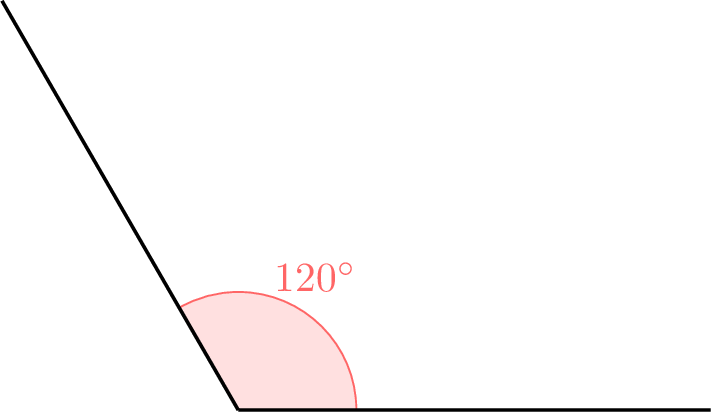
- Draw a ray using a ruler to create the first side of the angle.
- Place the protractor’s center on the endpoint of the ray (the vertex) and align the baseline with the ray at \(0^\circ\).
- Mark a point at \(120^\circ\) on the protractor’s scale (any angle greater than \(90^\circ\) but less than \(180^\circ\) is acceptable).
- Remove the protractor and use the ruler to draw a second ray from the vertex through the marked point.
Exercise
Using a pencil, a ruler, and a protractor, draw a right angle.
To draw a right angle, which measures \(90^\circ\):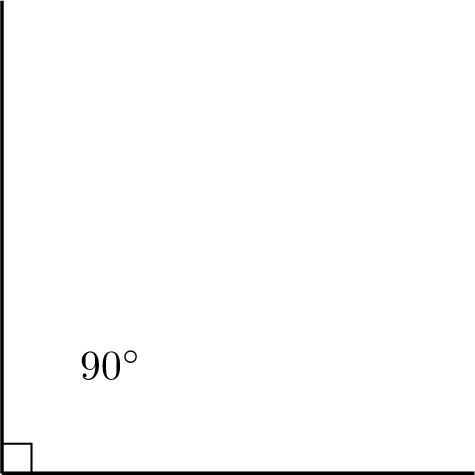
- Draw a ray using a ruler to create the first side of the angle.
- Place the protractor’s center on the endpoint of the ray (the vertex) and align the baseline with the ray at \(0^\circ\).
- Mark a point at \(90^\circ\) on the protractor’s scale.
- Remove the protractor and use the ruler to draw a second ray from the vertex through the marked point.
Angle Addition
Adding Angles
Exercise
Calculate the measure of \(\Angle{ABC}\).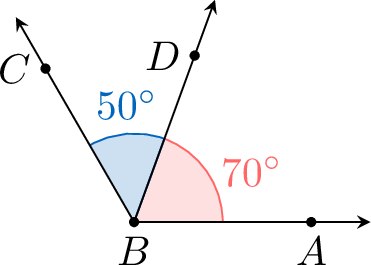
\(\Angle{ABC}=\)\(^\circ\)
\(\Angle{ABC}=\)\(^\circ\)
Using the angle addition postulate, \(\Angle{ABC}\) is the sum of the smaller angles \(\Angle{ABD}\) and \(\Angle{DBC}\):$$\begin{aligned}\Angle{ABC} &= \Angle{ABD} + \Angle{DBC} \\
&= 70^\circ + 50^\circ \\
&= 120^\circ\end{aligned}$$
Exercise
Calculate the measure of \(\Angle{FER}\).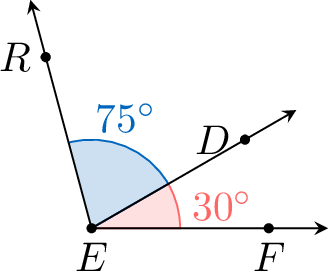
\(\Angle{FER}=\)\(^\circ\)
\(\Angle{FER}=\)\(^\circ\)
Using the angle addition postulate, \(\Angle{FER}\) is the sum of the smaller angles \(\Angle{FED}\) and \(\Angle{DER}\):$$\begin{aligned}\Angle{FER} &= \Angle{FED} + \Angle{DER} \\
&= 30^\circ + 75^\circ \\
&= 105^\circ\end{aligned}$$
Exercise
Calculate the measure of \(\Angle{FER}\).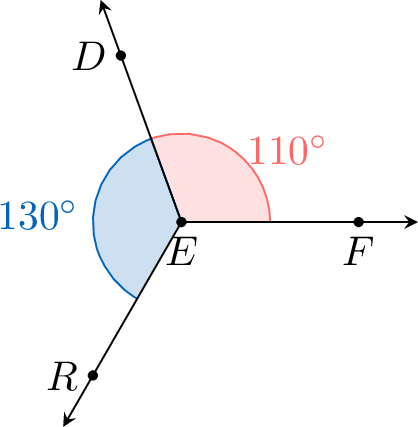
\(\Angle{FER}=\)\(^\circ\)
\(\Angle{FER}=\)\(^\circ\)
Using the angle addition postulate, \(\Angle{FER}\) is the sum of the smaller angles \(\Angle{FED}\) and \(\Angle{DER}\):$$\begin{aligned}\Angle{FER} &= \Angle{FED} + \Angle{DER} \\
&= 110^\circ + 130^\circ \\
&= 240^\circ\end{aligned}$$
Exercise
Calculate the measure of \(\Angle{FEM}\).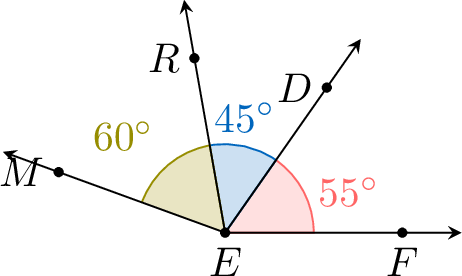
\(\Angle{FEM}=\)\(^\circ\)
\(\Angle{FEM}=\)\(^\circ\)
Using the angle addition postulate, \(\Angle{FEM}\) is the sum of the smaller angles \(\Angle{FED}\), \(\Angle{DER}\), and \(\Angle{REM}\):$$\begin{aligned}\Angle{FEM} &= \Angle{FED} + \Angle{DER} + \Angle{REM} \\
&= 55^\circ + 45^\circ + 60^\circ \\
&= 160^\circ\end{aligned}$$
Exercise
Calculate the measure of \(\Angle{FXM}\).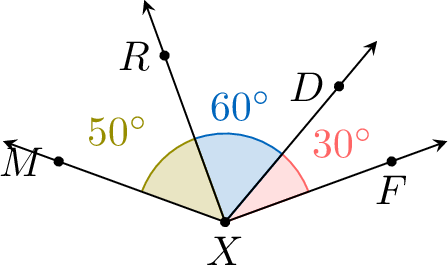
\(\Angle{FXM}=\)\(^\circ\)
\(\Angle{FXM}=\)\(^\circ\)
Using the angle addition postulate, \(\Angle{FXM}\) is the sum of the smaller angles \(\Angle{FXD}\), \(\Angle{DXR}\), and \(\Angle{RXM}\):$$\begin{aligned}\Angle{FXM} &= \Angle{FXD} + \Angle{DXR} + \Angle{RXM} \\
&= 30^\circ + 60^\circ + 50^\circ \\
&= 140^\circ\end{aligned}$$
Exercise
Calculate the measure of \(\Angle{MZP}\).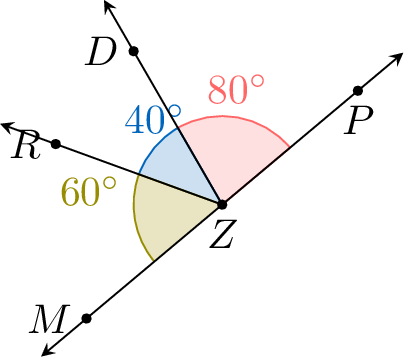
\(\Angle{MZP}=\)\(^\circ\)
\(\Angle{MZP}=\)\(^\circ\)
Using the angle addition postulate, \(\Angle{MZP}\) is the sum of the smaller angles \(\Angle{MZR}\), \(\Angle{RZD}\), and \(\Angle{DZP}\):$$\begin{aligned}\Angle{MZP} &= \Angle{MZR} + \Angle{RZD} + \Angle{DZP} \\
&= 60^\circ + 40^\circ + 80^\circ \\
&= 180^\circ\end{aligned}$$
Subtracting Angles
Exercise
Calculate the measure of \(\Angle{CBM}\).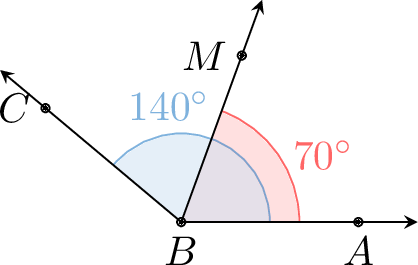
\(\Angle{CBM}=\)\(^\circ\)
\(\Angle{CBM}=\)\(^\circ\)
Using the angle addition postulate, the larger angle is the sum of the smaller angles:$$\Angle{CBM} + \Angle{MBA} = \Angle{CBA}$$To find \(\Angle{CBM}\), subtract \(\Angle{MBA}\) from \(\Angle{CBA}\):$$\begin{aligned}\Angle{CBM} &= \Angle{CBA} - \Angle{MBA} \\
&= 140^\circ - 70^\circ \\
&= 70^\circ\end{aligned}$$
Exercise
Calculate the measure of \(\Angle{FDN}\).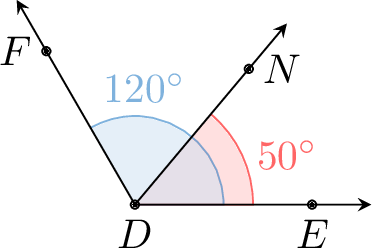
\(\Angle{FDN}=\)\(^\circ\)
\(\Angle{FDN}=\)\(^\circ\)
Using the angle addition postulate, the larger angle is the sum of the smaller angles:$$\Angle{FDN} + \Angle{NDE} = \Angle{FDE}$$To find \(\Angle{FDN}\), subtract \(\Angle{NDE}\) from \(\Angle{FDE}\):$$\begin{aligned}\Angle{FDN} &= \Angle{FDE} - \Angle{NDE} \\
&= 120^\circ - 50^\circ \\
&= 70^\circ\end{aligned}$$
Exercise
Calculate the measure of \(\Angle{IGJ}\).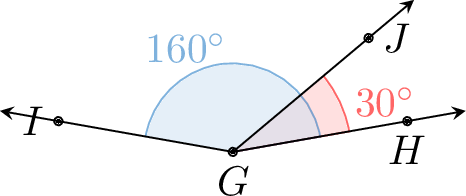
\(\Angle{IGJ}=\)\(^\circ\)
\(\Angle{IGJ}=\)\(^\circ\)
Using the angle addition postulate, the larger angle is the sum of the smaller angles:$$\Angle{IGJ} + \Angle{JGH} = \Angle{IGH}$$To find \(\Angle{IGJ}\), subtract \(\Angle{JGH}\) from \(\Angle{IGH}\):$$\begin{aligned}\Angle{IGJ} &= \Angle{IGH} - \Angle{JGH} \\
&= 160^\circ - 30^\circ \\
&= 130^\circ\end{aligned}$$
Exercise
Calculate the measure of \(\Angle{DZP}\) by subtracting the known angles from the larger angle using the angle addition postulate.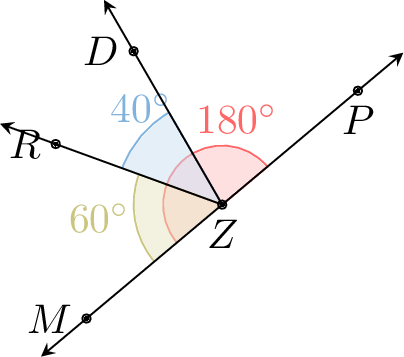
\(\Angle{DZP}=\)\(^\circ\)
\(\Angle{DZP}=\)\(^\circ\)
Using the angle addition postulate, the larger angle is the sum of the smaller angles:$$\Angle{MZR} + \Angle{RZD} + \Angle{DZP} = \Angle{MZP}$$To find \(\Angle{DZP}\), subtract \(\Angle{MZR}\) and \(\Angle{RZD}\) from \(\Angle{MZP}\):$$\begin{aligned}\Angle{DZP} &= \Angle{MZP} - \Angle{MZR} - \Angle{RZD} \\
&= 180^\circ - 60^\circ - 40^\circ \\
&= 80^\circ\end{aligned}$$
Exercise
Calculate the measure of \(\Angle{AOB}\) by subtracting the known angles from the larger angle using the angle addition postulate.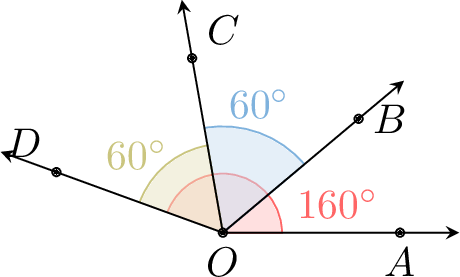
\(\Angle{AOB}=\)\(^\circ\)
\(\Angle{AOB}=\)\(^\circ\)
Using the angle addition postulate, the larger angle is the sum of the smaller angles:$$\Angle{AOB} + \Angle{BOC} + \Angle{COD} = \Angle{AOD}$$To find \(\Angle{AOB}\), subtract \(\Angle{BOC}\) and \(\Angle{COD}\) from \(\Angle{AOD}\):$$\begin{aligned}\Angle{AOB} &= \Angle{AOD} - \Angle{BOC} - \Angle{COD} \\
&= 160^\circ - 60^\circ - 60^\circ \\
&= 40^\circ\end{aligned}$$
Angle Properties
Calculating an Unknown Angle in a Right Angle
Exercise
Calculate the measure of the unknown angle.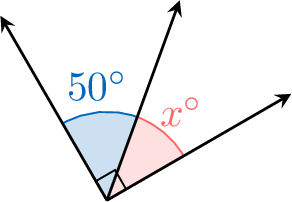
\(x^{\circ}=\)\(^{\circ}\)
\(x^{\circ}=\)\(^{\circ}\)
The sum of angles in a right angle is equal to \(90^\circ\).$$\begin{aligned}x^\circ + 50^\circ &= 90^\circ \\
x^\circ &= 90^\circ - 50^\circ \quad (\text{subtract } 50^\circ) \\
&= 40^\circ\end{aligned}$$
Exercise
Calculate the measure of the unknown angle.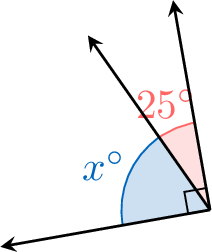
\(x^{\circ}=\)\(^{\circ}\)
\(x^{\circ}=\)\(^{\circ}\)
The sum of angles in a right angle is equal to \(90^\circ\).$$\begin{aligned}25^\circ + x^\circ &= 90^\circ \\
x^\circ &= 90^\circ - 25^\circ \quad (\text{subtract } 25^\circ) \\
&= 65^\circ\end{aligned}$$
Exercise
Calculate the measure of the unknown angle.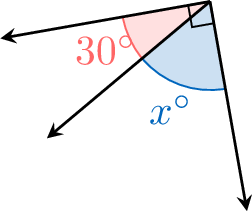
\(x^{\circ}=\)\(^{\circ}\)
\(x^{\circ}=\)\(^{\circ}\)
The sum of angles in a right angle is equal to \(90^\circ\).$$\begin{aligned}30^\circ + x^\circ &= 90^\circ \\
x^\circ &= 90^\circ - 30^\circ \quad (\text{subtract } 30^\circ) \\
&= 60^\circ\end{aligned}$$
Exercise
Calculate the measure of the unknown angle.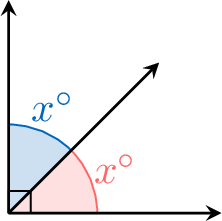
\(x^{\circ}=\)\(^{\circ}\)
\(x^{\circ}=\)\(^{\circ}\)
The sum of angles in a right angle is equal to \(90^\circ\). The two angles are equal (\(x^\circ\)).$$\begin{aligned}x^\circ + x^\circ &= 90^\circ \\
2x^\circ &= 90^\circ \quad (\text{combine like terms}) \\
x^\circ &= 90^\circ \div 2 \quad (\text{divide by } 2) \\
&= 45^\circ\end{aligned}$$
Exercise
Calculate the measure of the unknown angle.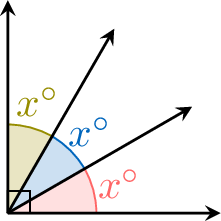
\(x^{\circ}=\)\(^{\circ}\)
\(x^{\circ}=\)\(^{\circ}\)
The sum of angles in a right angle is equal to \(90^\circ\). The three angles are equal (\(x^\circ\)).$$\begin{aligned}x^\circ + x^\circ + x^\circ &= 90^\circ \\
3x^\circ &= 90^\circ \quad (\text{combine like terms}) \\
x^\circ &= 90^\circ \div 3 \quad (\text{divide by } 3) \\
&= 30^\circ\end{aligned}$$
Calculating an Unknown Angle in a Straight Angle
Exercise
Calculate the measure of the unknown angle.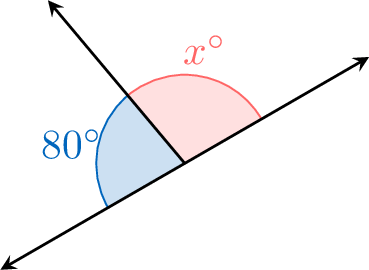
\(x^{\circ}=\)\(^{\circ}\)
\(x^{\circ}=\)\(^{\circ}\)
The sum of angles on a straight line is equal to \(180^\circ\).$$\begin{aligned}x^\circ + 80^\circ &= 180^\circ \\
x^\circ &= 180^\circ - 80^\circ \quad (\text{subtract } 80^\circ) \\
&= 100^\circ\end{aligned}$$
Exercise
Calculate the measure of the unknown angle.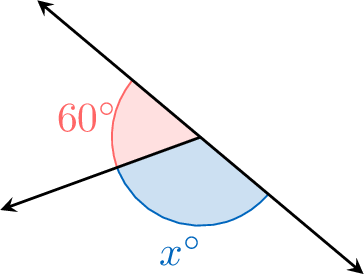
\(x^{\circ}=\)\(^{\circ}\)
\(x^{\circ}=\)\(^{\circ}\)
The sum of angles on a straight line is equal to \(180^\circ\).$$\begin{aligned}60^\circ + x^\circ &= 180^\circ \\
x^\circ &= 180^\circ - 60^\circ \quad (\text{subtract } 60^\circ) \\
&= 120^\circ\end{aligned}$$
Exercise
Calculate the measure of the unknown angle.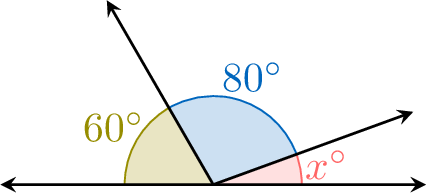
\(x^{\circ}=\)\(^{\circ}\)
\(x^{\circ}=\)\(^{\circ}\)
The sum of angles on a straight line is equal to \(180^\circ\).$$\begin{aligned}x^\circ + 80^\circ + 60^\circ &= 180^\circ \\
x^\circ &= 180^\circ - 80^\circ - 60^\circ \quad (\text{subtract } 80^\circ \text{ and } 60^\circ) \\
&= 40^\circ\end{aligned}$$
Exercise
Calculate the measure of the unknown angle.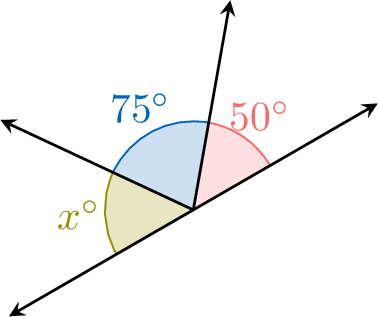
\(x^{\circ}=\)\(^{\circ}\)
\(x^{\circ}=\)\(^{\circ}\)
The sum of angles on a straight line is equal to \(180^\circ\).$$\begin{aligned}50^\circ + 75^\circ + x^\circ &= 180^\circ \\
x^\circ &= 180^\circ - 50^\circ - 75^\circ \quad (\text{subtract } 50^\circ \text{ and } 75^\circ) \\
&= 55^\circ\end{aligned}$$
Exercise
Calculate the measure of the unknown angle.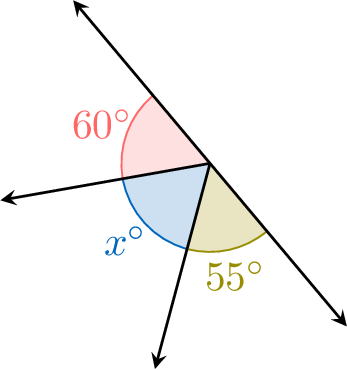
\(x^{\circ}=\)\(^{\circ}\)
\(x^{\circ}=\)\(^{\circ}\)
The sum of angles on a straight line is equal to \(180^\circ\).$$\begin{aligned}60^\circ + x^\circ + 55^\circ &= 180^\circ \\
x^\circ &= 180^\circ - 60^\circ - 55^\circ \quad (\text{subtract } 60^\circ \text{ and } 55^\circ) \\
&= 65^\circ\end{aligned}$$
Exercise
Calculate the measure of the unknown angle.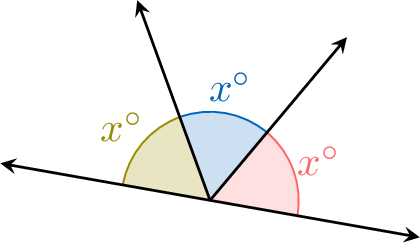
\(x^{\circ}=\)\(^{\circ}\)
\(x^{\circ}=\)\(^{\circ}\)
The sum of angles on a straight line is equal to \(180^\circ\). The three angles are equal (\(x^\circ\)).$$\begin{aligned}x^\circ + x^\circ + x^\circ &= 180^\circ \\
3x^\circ &= 180^\circ \quad (\text{combine like terms}) \\
x^\circ &= 180^\circ \div 3 \quad (\text{divide by } 3) \\
&= 60^\circ\end{aligned}$$
Calculating an Unknown Angle in a Full Angle
Exercise
Calculate the measure of the unknown angle.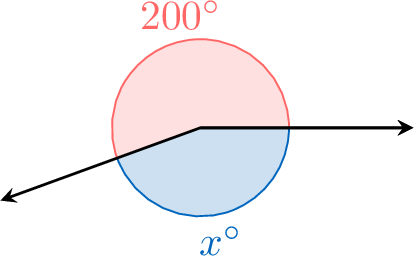
\(x^{\circ}=\)\(^{\circ}\)
\(x^{\circ}=\)\(^{\circ}\)
The sum of angles in a point is equal to \(360^{\circ}\).$$\begin{aligned}200^\circ + x^\circ &= 360^\circ \\
x^\circ &= 360^\circ - 200^\circ \quad (\text{subtract } 200^\circ) \\
&= 160^\circ\end{aligned}$$
Exercise
Calculate the measure of the unknown angle.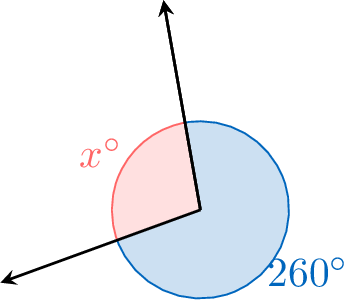
\(x^{\circ}=\)\(^{\circ}\)
\(x^{\circ}=\)\(^{\circ}\)
The sum of angles around a point is equal to \(360^{\circ}\).$$\begin{aligned}x^\circ + 260^\circ &= 360^\circ \\
x^\circ &= 360^\circ - 260^\circ \quad (\text{subtract } 260^\circ) \\
&= 100^\circ\end{aligned}$$
Exercise
Calculate the measure of the unknown angle.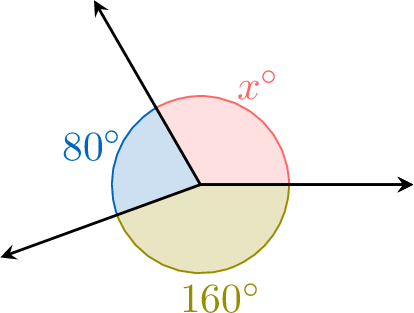
\(x^{\circ}=\)\(^{\circ}\)
\(x^{\circ}=\)\(^{\circ}\)
The sum of angles around a point is equal to \(360^{\circ}\).$$\begin{aligned}x^\circ + 80^\circ + 160^\circ &= 360^\circ \\
x^\circ &= 360^\circ - 80^\circ - 160^\circ \quad (\text{subtract } 80^\circ \text{ and } 160^\circ) \\
&= 120^\circ\end{aligned}$$
Exercise
Calculate the measure of the unknown angle.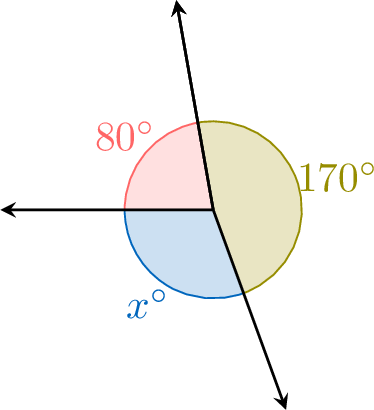
\(x^{\circ}=\)\(^{\circ}\)
\(x^{\circ}=\)\(^{\circ}\)
The sum of angles around a point is equal to \(360^{\circ}\).$$\begin{aligned}80^\circ + x^\circ + 170^\circ &= 360^\circ \\
x^\circ &= 360^\circ - 80^\circ - 170^\circ \quad (\text{subtract } 80^\circ \text{ and } 170^\circ) \\
&= 110^\circ\end{aligned}$$
Exercise
Calculate the measure of the unknown angle.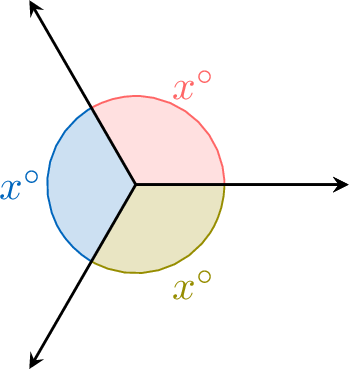
\(x^{\circ}=\)\(^{\circ}\)
\(x^{\circ}=\)\(^{\circ}\)
The sum of angles around a point is equal to \(360^{\circ}\). The three angles are equal (\(x^\circ\)).$$\begin{aligned}x^\circ + x^\circ + x^\circ &= 360^\circ \\
3x^\circ &= 360^\circ \quad (\text{combine like terms}) \\
x^\circ &= 360^\circ \div 3 \quad (\text{divide by } 3) \\
&= 120^\circ\end{aligned}$$