Vector Product
Definition
Calculating the Vector Product
Exercise
For \(\Vect{a}=\begin{pmatrix} 2 \\ 1 \\ -1 \end{pmatrix}\) and \(\Vect{b}=\begin{pmatrix} 1 \\ 2 \\ 3 \end{pmatrix}\), calculate:\(\Vect{a}\times \Vect{b} = \begin{pmatrix} \\ \\ \end{pmatrix}\)
$$\begin{aligned}[t]\Vect{a}\times \Vect{b} &= \begin{pmatrix} a_2b_3 - a_3b_2 \\
a_3b_1 - a_1b_3 \\
a_1b_2 - a_2b_1 \end{pmatrix} \\
&= \begin{pmatrix} (1)(3) - (-1)(2) \\
(-1)(1) - (2)(3) \\
(2)(2) - (1)(1) \end{pmatrix} \\
&= \begin{pmatrix} 3 - (-2) \\
-1 - 6 \\
4 - 1 \end{pmatrix} \\
&= \begin{pmatrix} 5 \\
-7 \\
3 \end{pmatrix}\end{aligned}$$
Exercise
For \(\Vect{b}=\begin{pmatrix} 1 \\ 2 \\ 3 \end{pmatrix}\) and \(\Vect{c}=\begin{pmatrix} 2 \\ 0 \\ 4 \end{pmatrix}\), calculate:\(\Vect{b}\times \Vect{c} = \begin{pmatrix} \\ \\ \end{pmatrix}\)
$$\begin{aligned}[t]\Vect{b}\times \Vect{c} &= \begin{pmatrix} b_2c_3 - b_3c_2 \\
b_3c_1 - b_1c_3 \\
b_1c_2 - b_2c_1 \end{pmatrix} \\
&= \begin{pmatrix} (2)(4) - (3)(0) \\
(3)(2) - (1)(4) \\
(1)(0) - (2)(2) \end{pmatrix} \\
&= \begin{pmatrix} 8 - 0 \\
6 - 4 \\
0 - 4 \end{pmatrix} \\
&= \begin{pmatrix} 8 \\
2 \\
-4 \end{pmatrix}\end{aligned}$$
Exercise
For \(\Vect{c}=\begin{pmatrix} -1 \\ 0 \\ 2 \end{pmatrix}\) and \(\Vect{d}=\begin{pmatrix} 1 \\ 3 \\ -2 \end{pmatrix}\), calculate:\(\Vect{c}\times \Vect{d} = \begin{pmatrix} \\ \\ \end{pmatrix}\)
$$\begin{aligned}[t]\Vect{c}\times \Vect{d} &= \begin{pmatrix} c_2d_3 - c_3d_2 \\
c_3d_1 - c_1d_3 \\
c_1d_2 - c_2d_1 \end{pmatrix} \\
&= \begin{pmatrix} (0)(-2) - (2)(3) \\
(2)(1) - (-1)(-2) \\
(-1)(3) - (0)(1) \end{pmatrix} \\
&= \begin{pmatrix} 0 - 6 \\
2 - 2 \\
-3 - 0 \end{pmatrix} \\
&= \begin{pmatrix} -6 \\
0 \\
-3 \end{pmatrix}\end{aligned}$$
Exercise
For \(\Vect{u}=\begin{pmatrix} 2 \\ -1 \\ 0 \end{pmatrix}\) and \(\Vect{v}=\begin{pmatrix} 3 \\ 1 \\ -4 \end{pmatrix}\), calculate:\(\Vect{u}\times \Vect{v} = \begin{pmatrix} \\ \\ \end{pmatrix}\)
$$\begin{aligned}[t]\Vect{u}\times \Vect{v} &= \begin{pmatrix} u_2v_3 - u_3v_2 \\
u_3v_1 - u_1v_3 \\
u_1v_2 - u_2v_1 \end{pmatrix} \\
&= \begin{pmatrix} (-1)(-4) - (0)(1) \\
(0)(3) - (2)(-4) \\
(2)(1) - (-1)(3) \end{pmatrix} \\
&= \begin{pmatrix} 4 - 0 \\
0 - (-8) \\
2 - (-3) \end{pmatrix} \\
&= \begin{pmatrix} 4 \\
8 \\
5 \end{pmatrix}\end{aligned}$$
Verifying Properties of the Vector Product
Exercise
Suppose \(\Vect{a}=\begin{pmatrix}1 \\ 2 \\ 3\end{pmatrix}\) and \(\Vect{b}=\begin{pmatrix}-1 \\ 3 \\ -1\end{pmatrix}\).
- Find \(\Vect{a} \times \Vect{b}\).
- Hence determine \(\Vect{a} \cdot (\Vect{a} \times \Vect{b})\) and \(\Vect{b} \cdot(\Vect{a} \times \Vect{b})\).
- Explain your results.
- Find \(\Vect{a} \times \Vect{b}\) $$ \begin{aligned}[t] \Vect{a}\times \Vect{b} &= \begin{pmatrix} 1 \\ 2 \\ 3 \end{pmatrix} \times \begin{pmatrix} -1 \\ 3 \\ -1 \end{pmatrix} \\ &= \begin{pmatrix} (2)(-1) - (3)(3) \\ (3)(-1) - (1)(-1) \\ (1)(3) - (2)(-1) \end{pmatrix} \\ &= \begin{pmatrix} -2 - 9 \\ -3 - (-1) \\ 3 - (-2) \end{pmatrix} \\ &= \begin{pmatrix} -11 \\ -2 \\ 5 \end{pmatrix} \end{aligned} $$
- Determine the scalar products Using the result from part 1: $$ \begin{aligned}[t] \Vect{a} \cdot (\Vect{a} \times \Vect{b}) &= \begin{pmatrix} 1 \\ 2 \\ 3 \end{pmatrix} \cdot \begin{pmatrix} -11 \\ -2 \\ 5 \end{pmatrix} \\ &= (1)(-11) + (2)(-2) + (3)(5) \\ &= -11 - 4 + 15 \\ &= 0 \end{aligned} $$ And for the second one: $$ \begin{aligned}[t] \Vect{b} \cdot (\Vect{a} \times \Vect{b}) &= \begin{pmatrix} -1 \\ 3 \\ -1 \end{pmatrix} \cdot \begin{pmatrix} -11 \\ -2 \\ 5 \end{pmatrix} \\ &= (-1)(-11) + (3)(-2) + (-1)(5) \\ &= 11 - 6 - 5 \\ &= 0 \end{aligned} $$
- Explanation The results are both zero. This is because, by definition, the vector product \(\Vect{a} \times \Vect{b}\) produces a vector that is orthogonal (perpendicular) to both \(\Vect{a}\) and \(\Vect{b}\). The scalar product of two orthogonal vectors is always zero. The calculations in part 2 verify this fundamental property.
Exercise
\(\Vect{i}, \Vect{j}\), and \(\Vect{k}\) are the base unit vectors in a 3D orthonormal system.
- Find \(\Vect{i} \times \Vect{i}, \Vect{j} \times \Vect{j}\), and \(\Vect{k} \times \Vect{k}\).
- Find \(\Vect{i} \times \Vect{j}\) and \(\Vect{j} \times \Vect{i}\).
The base unit vectors are \(\Vect{i}=\begin{pmatrix} 1 \\ 0 \\ 0 \end{pmatrix}\), \(\Vect{j}=\begin{pmatrix} 0 \\ 1 \\ 0 \end{pmatrix}\), and \(\Vect{k}=\begin{pmatrix} 0 \\ 0 \\ 1 \end{pmatrix}\).
- Cross product of a vector with itself $$ \Vect{i} \times \Vect{i} = \begin{pmatrix} 1 \\ 0 \\ 0 \end{pmatrix} \times \begin{pmatrix} 1 \\ 0 \\ 0 \end{pmatrix} = \begin{pmatrix} (0)(0)-(0)(0) \\ (0)(1)-(1)(0) \\ (1)(0)-(0)(1) \end{pmatrix} = \begin{pmatrix} 0 \\ 0 \\ 0 \end{pmatrix} = \Vect{0} $$ Similarly, \(\Vect{j} \times \Vect{j} = \Vect{0}\) and \(\Vect{k} \times \Vect{k} = \Vect{0}\).
- Cross product of two different base vectors $$ \Vect{i} \times \Vect{j} = \begin{pmatrix} 1 \\ 0 \\ 0 \end{pmatrix} \times \begin{pmatrix} 0 \\ 1 \\ 0 \end{pmatrix} = \begin{pmatrix} (0)(0)-(0)(1) \\ (0)(0)-(1)(0) \\ (1)(1)-(0)(0) \end{pmatrix} = \begin{pmatrix} 0 \\ 0 \\ 1 \end{pmatrix} = \Vect{k} $$ $$ \Vect{j} \times \Vect{i} = \begin{pmatrix} 0 \\ 1 \\ 0 \end{pmatrix} \times \begin{pmatrix} 1 \\ 0 \\ 0 \end{pmatrix} = \begin{pmatrix} (1)(0)-(0)(0) \\ (0)(1)-(0)(0) \\ (0)(0)-(1)(1) \end{pmatrix} = \begin{pmatrix} 0 \\ 0 \\ -1 \end{pmatrix} = -\Vect{k} $$
Exercise
For \(\Vect{a} = \begin{pmatrix} a_1 \\ a_2 \\ a_3 \end{pmatrix}\), prove that \(\Vect{a} \times \Vect{a}=\Vect{0}\).
We apply the definition of the vector product of \(\Vect{a}\) with itself.
Let \(\Vect{b} = \Vect{a}\), so \(b_1=a_1\), \(b_2=a_2\), and \(b_3=a_3\).$$\begin{aligned}[t]\Vect{a}\times \Vect{a} &= \begin{pmatrix} a_2a_3 - a_3a_2 \\ a_3a_1 - a_1a_3 \\ a_1a_2 - a_2a_1 \end{pmatrix} \\ &= \begin{pmatrix} 0 \\ 0 \\ 0 \end{pmatrix} \\ &= \Vect{0}\end{aligned}$$Since the multiplication of real numbers is commutative (\(ab=ba\)), each component simplifies to zero.
Let \(\Vect{b} = \Vect{a}\), so \(b_1=a_1\), \(b_2=a_2\), and \(b_3=a_3\).$$\begin{aligned}[t]\Vect{a}\times \Vect{a} &= \begin{pmatrix} a_2a_3 - a_3a_2 \\ a_3a_1 - a_1a_3 \\ a_1a_2 - a_2a_1 \end{pmatrix} \\ &= \begin{pmatrix} 0 \\ 0 \\ 0 \end{pmatrix} \\ &= \Vect{0}\end{aligned}$$Since the multiplication of real numbers is commutative (\(ab=ba\)), each component simplifies to zero.
Exercise
For \(\Vect{a} = \begin{pmatrix} a_1 \\ a_2 \\ a_3 \end{pmatrix}\) and \(\Vect{b} = \begin{pmatrix} b_1 \\ b_2 \\ b_3 \end{pmatrix}\), prove that \(\Vect{a} \times \Vect{b}=-\Vect{b}\times \Vect{a} \).
$$\begin{aligned} \Vect{a}\times \Vect{b} &= \begin{pmatrix} a_1 \\
a_2 \\
a_3 \end{pmatrix} \times \begin{pmatrix} b_1 \\
b_2 \\
b_3 \end{pmatrix}\\
&=\begin{pmatrix} a_2b_3 - a_3b_2 \\
a_3b_1 - a_1b_3 \\
a_1b_2 - a_2b_1 \end{pmatrix}\\
&= \begin{pmatrix} -(a_3b_2 - a_2b_3) \\
-(a_1b_3 - a_3b_1) \\
-(a_2b_1 - a_1b_2) \end{pmatrix} \\
&= -\begin{pmatrix} a_3b_2 - a_2b_3 \\
a_1b_3 - a_3b_1 \\
a_2b_1 - a_1b_2 \end{pmatrix} \\
&= -\left( \begin{pmatrix} b_1 \\
b_2 \\
b_3 \end{pmatrix}\times \begin{pmatrix} a_1 \\
a_2 \\
a_3 \end{pmatrix} \right)\\
&= -\left( \Vect{b}\times \Vect{a}\right) \end{aligned} $$Therefore, we have shown that \(\Vect{a} \times \Vect{b} = -(\Vect{b} \times \Vect{a})\).
Exercise
Let \(\Vect{a} = \begin{pmatrix} a_1 \\ a_2 \\ a_3 \end{pmatrix}\), \(\Vect{b} = \begin{pmatrix} b_1 \\ b_2 \\ b_3 \end{pmatrix}\), and \(\Vect{c} = \begin{pmatrix} c_1 \\ c_2 \\ c_3 \end{pmatrix}\) be three vectors in space. Prove the distributive property of the vector product:$$ \Vect{a} \times (\Vect{b}+\Vect{c}) = (\Vect{a} \times \Vect{b}) + (\Vect{a} \times \Vect{c}) $$
We will prove this property by expanding both sides of the equation by their components.
- Left-Hand Side (LHS): First, we find the sum \(\Vect{b}+\Vect{c}\): $$ \Vect{b}+\Vect{c} = \begin{pmatrix} b_1+c_1 \\ b_2+c_2 \\ b_3+c_3 \end{pmatrix} $$ Now we calculate \(\Vect{a} \times (\Vect{b}+\Vect{c})\): $$ \begin{aligned} \Vect{a} \times (\Vect{b}+\Vect{c}) &= \begin{pmatrix} a_1 \\ a_2 \\ a_3 \end{pmatrix} \times \begin{pmatrix} b_1+c_1 \\ b_2+c_2 \\ b_3+c_3 \end{pmatrix} \\ &= \begin{pmatrix} a_2(b_3+c_3) - a_3(b_2+c_2) \\ a_3(b_1+c_1) - a_1(b_3+c_3) \\ a_1(b_2+c_2) - a_2(b_1+c_1) \end{pmatrix} \\ &= \begin{pmatrix} a_2b_3 + a_2c_3 - a_3b_2 - a_3c_2 \\ a_3b_1 + a_3c_1 - a_1b_3 - a_1c_3 \\ a_1b_2 + a_1c_2 - a_2b_1 - a_2c_1 \end{pmatrix} \end{aligned} $$
- Right-Hand Side (RHS): First, we find the two separate cross products: $$ \Vect{a} \times \Vect{b} = \begin{pmatrix} a_2b_3 - a_3b_2 \\ a_3b_1 - a_1b_3 \\ a_1b_2 - a_2b_1 \end{pmatrix} \quad \text{and} \quad \Vect{a} \times \Vect{c} = \begin{pmatrix} a_2c_3 - a_3c_2 \\ a_3c_1 - a_1c_3 \\ a_1c_2 - a_2c_1 \end{pmatrix} $$ Now we add them together: $$ \begin{aligned} (\Vect{a} \times \Vect{b}) + (\Vect{a} \times \Vect{c}) &= \begin{pmatrix} (a_2b_3 - a_3b_2) + (a_2c_3 - a_3c_2) \\ (a_3b_1 - a_1b_3) + (a_3c_1 - a_1c_3) \\ (a_1b_2 - a_2b_1) + (a_1c_2 - a_2c_1) \end{pmatrix} \\ &= \begin{pmatrix} a_2b_3 + a_2c_3 - a_3b_2 - a_3c_2 \\ a_3b_1 + a_3c_1 - a_1b_3 - a_1c_3 \\ a_1b_2 + a_1c_2 - a_2b_1 - a_2c_1 \end{pmatrix} \end{aligned} $$
Geometric Interpretation
Applying the Right-Hand Rule
Mcq
The diagram below illustrates three vectors, \(\Vect{a}\), \(\Vect{b}\), and their vector product \(\Vect{a} \times \Vect{b}\).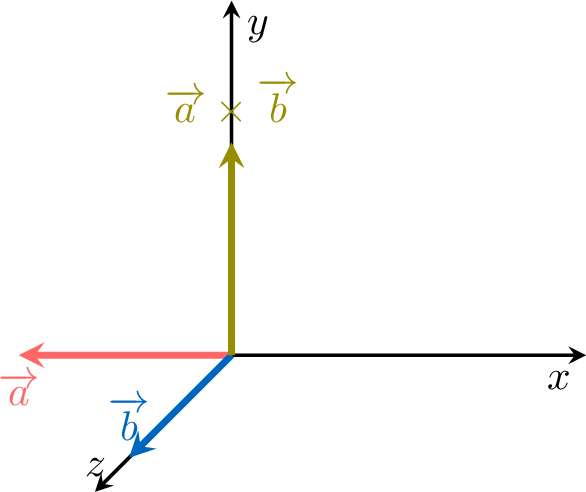
Yes. By pointing the fingers of the right hand in the direction of \(\Vect{a}\) (along the negative x-axis) and curling them toward the direction of \(\Vect{b}\) (along the positive z-axis), the thumb points in the direction of the positive y-axis.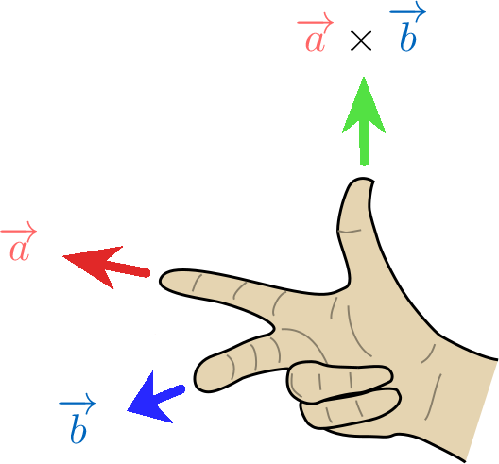
Mcq
The diagram below illustrates three vectors, \(\Vect{v}\), \(\Vect{w}\), and their vector product \(\Vect{v} \times \Vect{w}\).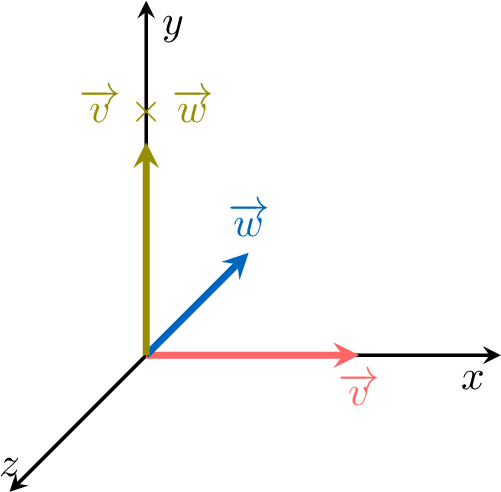
Yes. By pointing the fingers of the right hand in the direction of \(\Vect{v}\) (along the positive x-axis) and curling them toward the direction of \(\Vect{w}\) (along the negative z-axis), the thumb correctly points in the direction of the positive y-axis.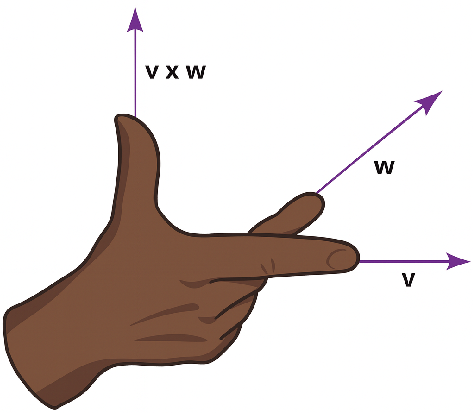
Mcq
The diagram below illustrates three vectors, \(\Vect{v}\), \(\Vect{w}\), and their vector product \(\Vect{v} \times \Vect{w}\).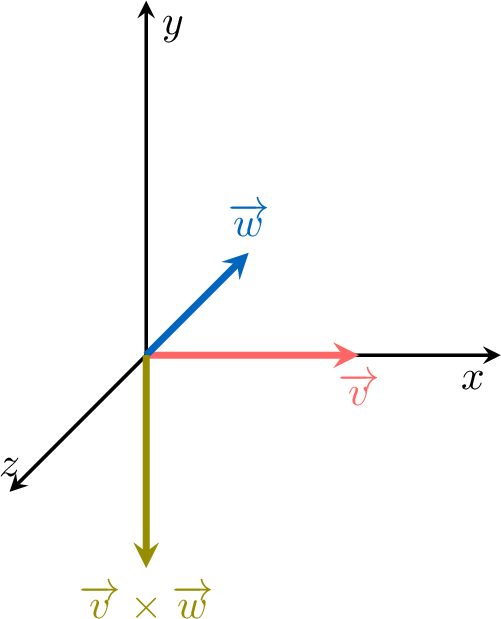
No. By pointing the fingers of the right hand in the direction of \(\Vect{v}\) (along the positive x-axis) and curling them toward the direction of \(\Vect{w}\) (along the negative z-axis), the thumb points in the direction of the positive y-axis.
Mcq
The diagram below illustrates three vectors, \(\Vect{a}\), \(\Vect{b}\), and their vector product \(\Vect{a} \times \Vect{b}\).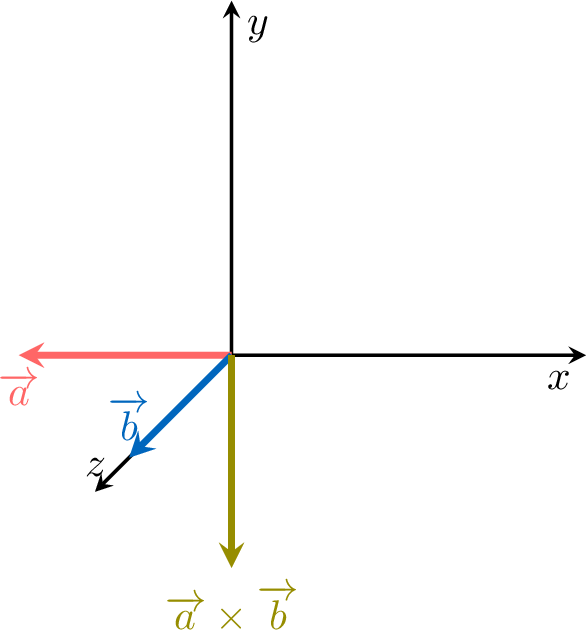
No. By pointing the fingers of the right hand in the direction of \(\Vect{a}\) (along the negative x-axis) and curling them toward the direction of \(\Vect{b}\) (along the positive z-axis), the thumb points in the direction of the positive y-axis.
Calculating Area using the Vector Product
Exercise
Consider the points \(A(1, 1, 1)\), \(B(3, 2, 1)\), and \(C(1, 3, 3)\).
Calculate the area of the parallelogram with adjacent sides \(\Segment{AB}\) and \(\Segment{AC}\).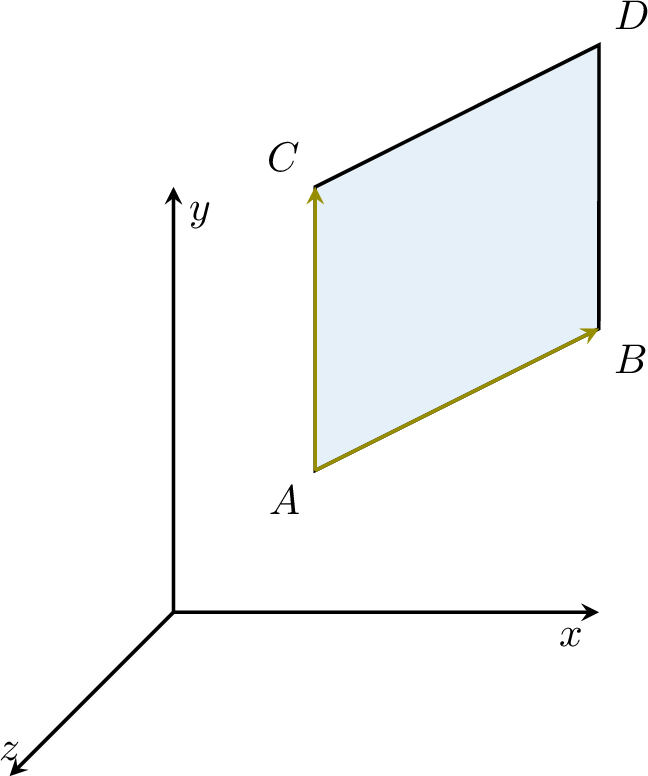
Calculate the area of the parallelogram with adjacent sides \(\Segment{AB}\) and \(\Segment{AC}\).
The area of a parallelogram defined by two vectors is equal to the magnitude of their vector product: Area \(= |\Vect{AB} \times \Vect{AC}|\).
- Determine the component vectors $$ \Vect{AB} = \begin{pmatrix} 3-1 \\ 2-1 \\ 1-1 \end{pmatrix} = \begin{pmatrix} 2 \\ 1 \\ 0 \end{pmatrix} $$ $$ \Vect{AC} = \begin{pmatrix} 1-1 \\ 3-1 \\ 3-1 \end{pmatrix} = \begin{pmatrix} 0 \\ 2 \\ 2 \end{pmatrix} $$
- Calculate the vector product \(\Vect{AB} \times \Vect{AC}\) $$ \begin{aligned}[t] \Vect{AB} \times \Vect{AC} &= \begin{pmatrix} 2 \\ 1 \\ 0 \end{pmatrix} \times \begin{pmatrix} 0 \\ 2 \\ 2 \end{pmatrix} \\ &= \begin{pmatrix} (1)(2) - (0)(2) \\ (0)(0) - (2)(2) \\ (2)(2) - (1)(0) \end{pmatrix} \\ &= \begin{pmatrix} 2 \\ -4 \\ 4 \end{pmatrix} \end{aligned} $$
- Calculate the magnitude of the resulting vector $$ \begin{aligned}[t] \text{Area} &= |\Vect{AB} \times \Vect{AC}|\\ &= \left\| \begin{pmatrix} 2 \\ -4 \\ 4 \end{pmatrix} \right\| \\ &= \sqrt{2^2 + (-4)^2 + 4^2} \\ &= \sqrt{4 + 16 + 16} \\ &= \sqrt{36} \\ &= 6 \end{aligned} $$
Exercise
Consider the points \(A(1, 1, 1)\), \(B(3, 2, 1)\), and \(C(1, 3, 3)\).
Calculate the area of the parallelogram with adjacent sides \(\Vect{AB}\) and \(\Vect{AC}\).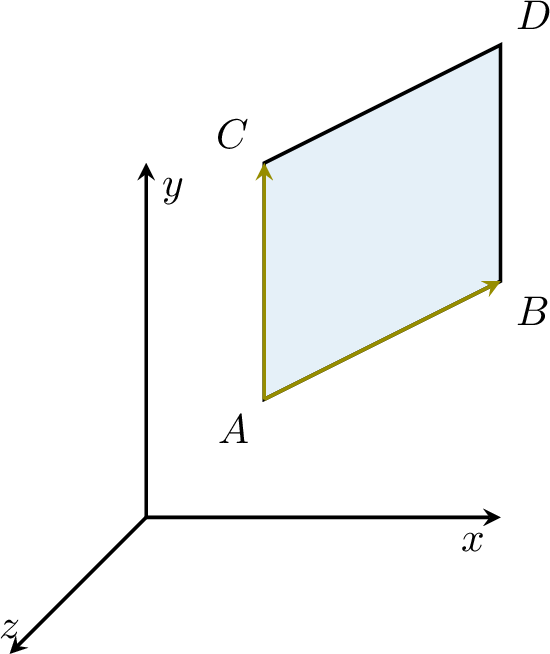
Calculate the area of the parallelogram with adjacent sides \(\Vect{AB}\) and \(\Vect{AC}\).
The area of a parallelogram defined by two vectors is equal to the magnitude of their vector product: Area \(= |\Vect{AB} \times \Vect{AC}|\).
- Determine the component vectors $$ \Vect{AB} = \begin{pmatrix} 3-1 \\ 2-1 \\ 1-1 \end{pmatrix} = \begin{pmatrix} 2 \\ 1 \\ 0 \end{pmatrix} $$ $$ \Vect{AC} = \begin{pmatrix} 1-1 \\ 3-1 \\ 3-1 \end{pmatrix} = \begin{pmatrix} 0 \\ 2 \\ 2 \end{pmatrix} $$
- Calculate the vector product \(\Vect{AB} \times \Vect{AC}\) $$ \begin{aligned}[t] \Vect{AB} \times \Vect{AC} &= \begin{pmatrix} 2 \\ 1 \\ 0 \end{pmatrix} \times \begin{pmatrix} 0 \\ 2 \\ 2 \end{pmatrix} \\ &= \begin{pmatrix} (1)(2) - (0)(2) \\ (0)(0) - (2)(2) \\ (2)(2) - (1)(0) \end{pmatrix} \\ &= \begin{pmatrix} 2 \\ -4 \\ 4 \end{pmatrix} \end{aligned} $$
- Calculate the magnitude of the resulting vector $$ \begin{aligned}[t] \text{Area} &= |\Vect{AB} \times \Vect{AC}|\\ &= \left\| \begin{pmatrix} 2 \\ -4 \\ 4 \end{pmatrix} \right\| \\ &= \sqrt{2^2 + (-4)^2 + 4^2} \\ &= \sqrt{4 + 16 + 16} \\ &= \sqrt{36} \\ &= 6 \end{aligned} $$
Exercise
Consider the points \(A(1, 1, 1)\), \(B(3, 2, 1)\), and \(C(1, 3, 3)\).
Calculate the area of the triangle ABC.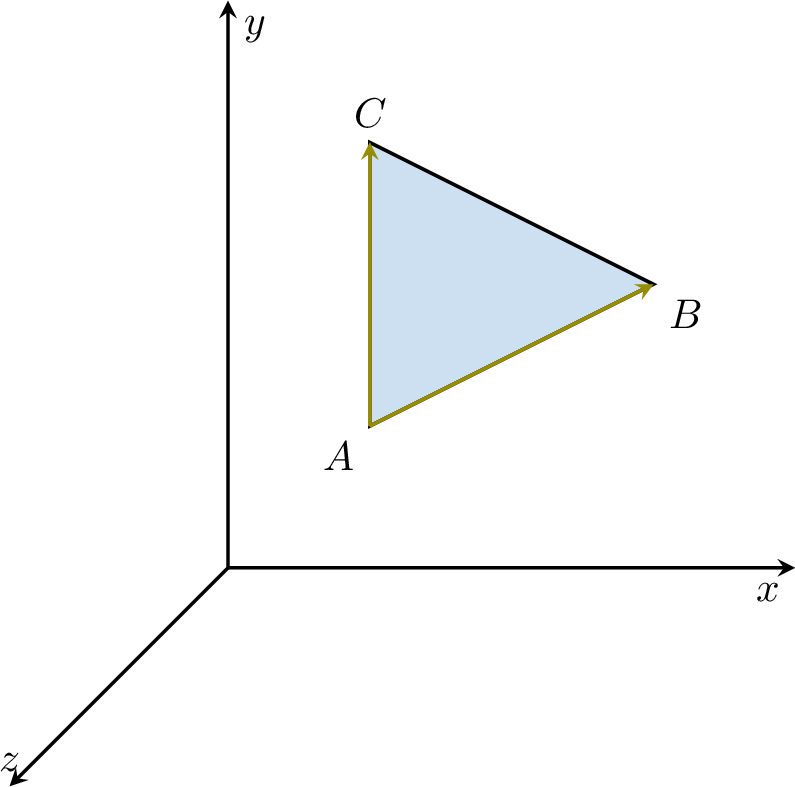
Calculate the area of the triangle ABC.
The area of a triangle defined by two vectors is half the magnitude of their vector product, since this triangle is half of the parallelogram built on those vectors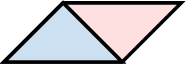 : Area \(= \frac{1}{2}|\Vect{AB} \times \Vect{AC}|\).
: Area \(= \frac{1}{2}|\Vect{AB} \times \Vect{AC}|\).- Determine the component vectors $$ \Vect{AB} = \begin{pmatrix} 3-1 \\ 2-1 \\ 1-1 \end{pmatrix} = \begin{pmatrix} 2 \\ 1 \\ 0 \end{pmatrix} $$ $$ \Vect{AC} = \begin{pmatrix} 1-1 \\ 3-1 \\ 3-1 \end{pmatrix} = \begin{pmatrix} 0 \\ 2 \\ 2 \end{pmatrix} $$
- Calculate the vector product \(\Vect{AB} \times \Vect{AC}\) $$ \begin{aligned}[t] \Vect{AB} \times \Vect{AC} &= \begin{pmatrix} 2 \\ 1 \\ 0 \end{pmatrix} \times \begin{pmatrix} 0 \\ 2 \\ 2 \end{pmatrix} \\ &= \begin{pmatrix} (1)(2) - (0)(2) \\ (0)(0) - (2)(2) \\ (2)(2) - (1)(0) \end{pmatrix} \\ &= \begin{pmatrix} 2 \\ -4 \\ 4 \end{pmatrix} \end{aligned} $$
- Calculate the magnitude and the area The magnitude of the cross product vector is: $$ \begin{aligned}[t] |\Vect{AB} \times \Vect{AC}| &= \left\| \begin{pmatrix} 2 \\ -4 \\ 4 \end{pmatrix} \right\| \\ &= \sqrt{2^2 + (-4)^2 + 4^2} \\ &= \sqrt{4 + 16 + 16} = \sqrt{36} = 6 \end{aligned} $$ The area of the triangle is half of this magnitude: $$ \text{Area of Triangle} = \frac{1}{2} |\Vect{AB} \times \Vect{AC}| = \frac{1}{2} \times 6 = 3 $$
Exercise
Consider the points \(A(0, 0, 0)\), \(B(-1, 2, 3)\), and \(C(1, 2, 6)\).
Calculate the area of the triangle ABC.
Calculate the area of the triangle ABC.
The area of a triangle defined by two vectors is half the magnitude of their vector product, since this triangle is half of the parallelogram built on those vectors: Area \(= \frac{1}{2}|\Vect{AB} \times \Vect{AC}|\).
- Determine the component vectors Since A is the origin, the components of the vectors are simply the coordinates of the points B and C. $$ \Vect{AB} = \begin{pmatrix} -1 \\ 2 \\ 3 \end{pmatrix} $$ $$ \Vect{AC} = \begin{pmatrix} 1 \\ 2 \\ 6 \end{pmatrix} $$
- Calculate the vector product \(\Vect{AB} \times \Vect{AC}\) $$ \begin{aligned}[t] \Vect{AB} \times \Vect{AC} &= \begin{pmatrix} -1 \\ 2 \\ 3 \end{pmatrix} \times \begin{pmatrix} 1 \\ 2 \\ 6 \end{pmatrix} \\ &= \begin{pmatrix} (2)(6) - (3)(2) \\ (3)(1) - (-1)(6) \\ (-1)(2) - (2)(1) \end{pmatrix} \\ &= \begin{pmatrix} 12 - 6 \\ 3 - (-6) \\ -2 - 2 \end{pmatrix} \\ &= \begin{pmatrix} 6 \\ 9 \\ -4 \end{pmatrix} \end{aligned} $$
- Calculate the magnitude and the area The magnitude of the cross product vector is: $$ \begin{aligned}[t] |\Vect{AB} \times \Vect{AC}| &= \left\| \begin{pmatrix} 6 \\ 9 \\ -4 \end{pmatrix} \right\| \\ &= \sqrt{6^2 + 9^2 + (-4)^2} \\ &= \sqrt{36 + 81 + 16} = \sqrt{133} \end{aligned} $$ The area of the triangle is half of this magnitude: $$ \text{Area of Triangle} = \frac{1}{2} |\Vect{AB} \times \Vect{AC}| = \frac{\sqrt{133}}{2} $$