CommeUnJeu · Grade 6
Proportionality
Discover the essentials of proportionality. Learn to identify proportional relationships using ratios and coefficients, organize data in tables, and calculate unit rates. Master four methods for finding the fourth proportional through real-world applications like pricing and travel.
I
What is Proportionality?
Imagine you are buying cookies. Each cookie costs \(\dollar 2\). The number of cookies is \(\textcolor{colordef}{x}\) and the total cost is \(\textcolor{colorprop}{y}\). We have:

| \(\textcolor{colordef}{1}\) cookie costs | \(\textcolor{colorprop}{2} = \textcolor{olive}{2} \times \textcolor{colordef}{1}\) |
| \(\textcolor{colordef}{2}\) cookies cost | \(\textcolor{colorprop}{4} = \textcolor{olive}{2} \times \textcolor{colordef}{2}\) |
| \(\textcolor{colordef}{3}\) cookies cost | \(\textcolor{colorprop}{6} = \textcolor{olive}{2} \times \textcolor{colordef}{3}\) |
| \(\textcolor{colordef}{4}\) cookies cost | \(\textcolor{colorprop}{8} = \textcolor{olive}{2} \times \textcolor{colordef}{4}\) |
| \(\textcolor{colordef}{x}\) cookies cost | \(\textcolor{colorprop}{y} = \textcolor{olive}{2} \times \textcolor{colordef}{x}\) |
- Ratio definition: No matter how many cookies you buy, the ratio \(\dfrac{\textcolor{colorprop}{y}}{\textcolor{colordef}{x}}\) is always the same and equal to the price of one cookie:$$\dfrac{\textcolor{colorprop}{8}}{\textcolor{colordef}{4}} =\dfrac{\textcolor{colorprop}{6}}{\textcolor{colordef}{3}} = \dfrac{\textcolor{colorprop}{4}}{\textcolor{colordef}{2}} = \dfrac{\textcolor{colorprop}{y}}{\textcolor{colordef}{x}} =\textcolor{olive}{2}.$$
- Linearity definition: The total cost can also be expressed with a formula (a linear function):$$\textcolor{colorprop}{y} = \textcolor{olive}{2} \times \textcolor{colordef}{x}.$$
Definition — Proportional
Two variables \(\textcolor{colordef}{x}\) and \(\textcolor{colorprop}{y}\) are proportional if the ratio \(\dfrac{\textcolor{colorprop}{y}}{\textcolor{colordef}{x}}\) is constant, equal to a value \(\textcolor{olive}{k}\) called the coefficient of proportionality:$$\dfrac{\textcolor{colorprop}{y}}{\textcolor{colordef}{x}} = \textcolor{olive}{k}.$$Equivalently, \(\textcolor{colorprop}{y}\) is proportional to \(\textcolor{colordef}{x}\) if, for the same constant \(\textcolor{olive}{k}\),$$ \textcolor{colorprop}{y} = \textcolor{olive}{k}\times \textcolor{colordef}{x}.$$Example
Does this table represent a proportional relationship?| \(\textcolor{colordef}{x}\) | \(\textcolor{colordef}{1}\) | \(\textcolor{colordef}{2}\) | \(\textcolor{colordef}{3}\) |
| \(\textcolor{colorprop}{y}\) | \(\textcolor{colorprop}{15}\) | \(\textcolor{colorprop}{30}\) | \(\textcolor{colorprop}{45}\) |
Yes. The table represents a proportional relationship because each ratio is equal:$$\dfrac{\textcolor{colorprop}{15}}{\textcolor{colordef}{1}} = \dfrac{\textcolor{colorprop}{30}}{\textcolor{colordef}{2}} = \dfrac{\textcolor{colorprop}{45}}{\textcolor{colordef}{3}} = \textcolor{olive}{15}.$$
Skills to practice
- Recognizing a Proportional Table
- Testing Proportional Relationships in Word Problems
- Calculating the Coefficient of Proportionality in Proportional Tables
- Calculating the Unit Rate in Proportional Contexts
- Calculating the Unit Rate in Proportional Contexts
- Using Unit Rates to Calculate a Total
- Using Unit Rates to Calculate a Missing Quantity
II
Calculating a Fourth Proportional
Method — Calculating a Fourth Proportional
If 4 tickets cost \(\dollar 28\), how much do 6 tickets cost if each ticket costs the same?- Method 1: Using the Coefficient of Proportionality
Find the unit price (price for 1 ticket):$$\text{Unit price} = \dfrac{28}{4} = 7.$$Now multiply by 6 for 6 tickets:$$\text{Total for 6 tickets} = 7 \times 6 = 42.$$ - Method 2: Proportion Equation$$\begin{aligned}\dfrac{\textcolor{colorprop}{28}}{\textcolor{colordef}{4}} &= \dfrac{\textcolor{colorprop}{x}}{\textcolor{colordef}{6}} \\ \textcolor{colordef}{4} \times \textcolor{colorprop}{x} &= \textcolor{colorprop}{28} \times \textcolor{colordef}{6} && \text{(cross-multiplication)} \\ \textcolor{colorprop}{x} &= \dfrac{\textcolor{colorprop}{28} \times \textcolor{colordef}{6}}{\textcolor{colordef}{4}} \\ \textcolor{colorprop}{x} &= \textcolor{colorprop}{42}\end{aligned}$$
- Method 3: Unit Rate with Equivalent Ratios
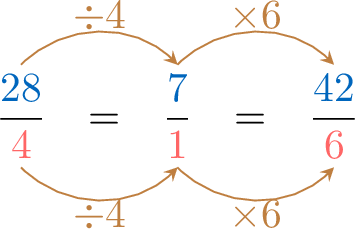
- Method 4: Cross-multiplication (Product in Cross)
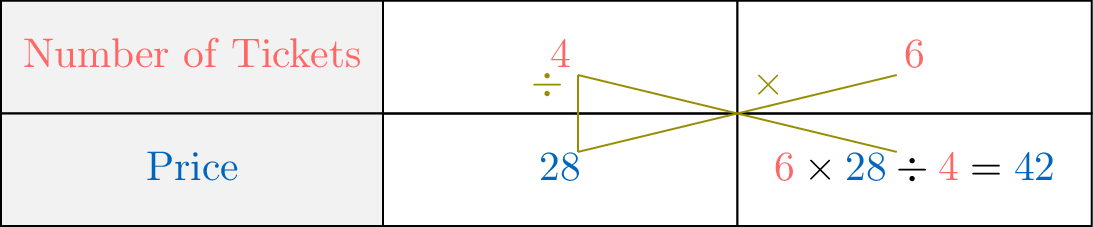
Skills to practice
- Calculating a Fourth Proportional
- Finding Missing Values in a Proportional Table
III
Review \& Beyond
Skills to practice
- Quiz
Jump to section