French National Education · Grade 4
Times
Master units of time and conversions. Covers the 24-hour clock, reading analog clocks to the minute, and working with mixed units (minutes and seconds). Includes practical exercises on time intervals and transforming AM/PM times into 24-hour format.
I
Units of Time
A unit of time is a standard way to measure how long something lasts. We choose the best unit based on the duration of the event.
Definition — Common Units of Time
Here are the most common units, from smallest to largest:- Second (s): For very short moments, like blinking an eye.
- Minute (min): For short durations, like the time it takes to brush your teeth.
- Hour (h): For longer activities, like a lesson at school or a movie.
- Day (d): A full cycle of daytime and nighttime.
- Week (wk): A group of 7 days.
- Month (mo): Used to divide a year into parts, such as the months in a season.
- Year (yr): A long period, used to measure our age or the time between holidays.
Example
Which unit of time is most appropriate for measuring how long it takes to run a 100-meter sprint?
A 100-meter sprint is a very fast event, usually lasting only a few seconds.
- An hour or a minute would be far too long.
- The best unit for this quick action is seconds (s).
Skills to practice
- Choosing Appropriate Units of Time
II
Converting Units of Time
Definition — Converting Units of Time
To convert between units, we must know their relationships:- 1 minute = 60 seconds
- 1 hour = 60 minutes
- 1 day = 24 hours
- 1 week = 7 days
- 1 year = 12 months \(\approx 52\) weeks = 365 days
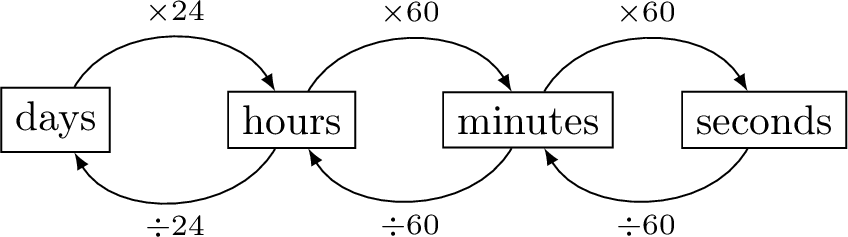
Method — How to Convert Units
- To convert from a larger unit to a smaller one, you multiply. (There are many smaller units in one larger unit.)
- To convert from a smaller unit to a larger one, you divide. (You are putting many small units together to make a bigger unit.)
Example
Convert 2 minutes to seconds.
We are going from a larger unit (minutes) to a smaller one (seconds), so we multiply.
Since 1 minute = 60 seconds:$$\begin{aligned}[t]2 \, \text{min} &= 2 \times 60 \, \text{s} \\ &= 120 \, \text{s}\end{aligned}$$So, 2 minutes is 120 seconds.
Since 1 minute = 60 seconds:$$\begin{aligned}[t]2 \, \text{min} &= 2 \times 60 \, \text{s} \\ &= 120 \, \text{s}\end{aligned}$$So, 2 minutes is 120 seconds.
Example
Convert 120 seconds to minutes.
We are going from a smaller unit (seconds) to a larger one (minutes), so we divide.
Since 1 minute = 60 seconds:$$\begin{aligned}[t]120 \div 60 &= 2 \\ 120 \, \text{s} &= 2 \, \text{min}\end{aligned}$$So, 120 seconds is 2 minutes.
Since 1 minute = 60 seconds:$$\begin{aligned}[t]120 \div 60 &= 2 \\ 120 \, \text{s} &= 2 \, \text{min}\end{aligned}$$So, 120 seconds is 2 minutes.
Skills to practice
- Converting Units of Time From Bigger to Smaller
- Converting Units of Time From Smaller to Bigger
- Working with Fractions of Time
III
Converting to Mixed Time Units
Method — Converting Seconds into Minutes and Seconds
To write a time given in seconds as a combination of minutes and seconds, we use division. This method helps us find how many full groups of 60 seconds (minutes) we can make.- Divide by 60. Since there are 60 seconds in 1 minute, divide the total number of seconds by 60.
- The quotient is the minutes. The whole-number answer you get (the quotient) is the number of full minutes.
- The remainder is the seconds. The number left over from the division (the remainder) is the number of seconds that are left.
Example
You run a race in 140 seconds. How many minutes and seconds is that?
Let’s use our method to convert 140 seconds.
- Step 1: Divide by 60.
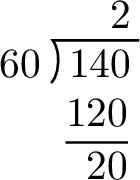
- Step 2: Identify the quotient and remainder.
- The quotient is 2.
- The remainder is 20.
- Step 3: Interpret the result.
- The quotient (2) means we have 2 full minutes.
- The remainder (20) means we have 20 seconds left over.
Skills to practice
- Combining Units into a Single Unit
- Separating a Single Unit into Mixed Units
IV
24-Hour Time Format
Definition — 24-Hour Time
The 24-hour clock is a system for telling time that avoids using AM and PM. The day runs from 00:00 (midnight) to 23:59. Sometimes 24:00 is used to show midnight at the very end of the day; it is the same moment as 00:00 on the next day. This format is used in many parts of the world, in the military, and for travel schedules to avoid confusion.
Example
Write 6:15 PM in 24-hour format.
To convert a PM time to 24-hour format, you add 12 to the hour.$$\begin{aligned}[t]6:15 \, \text{PM} &= 12 \, \text{h} + 6 \, \text{h} + 15 \, \text{min} \\
&= 18 \, \text{h} + 15 \, \text{min} \\
&= 18:15\end{aligned}$$So, 6:15 PM becomes 18:15.
Skills to practice
- Telling Time the 24-Hour Way
- Finding Everyday Time from 24-Hour Clocks
V
Reading Analog Clocks
Method — How to Read an Analog Clock
To read time to the exact minute, we look at both hands and the small tick marks on the clock face.- Read the Hour Hand (the short hand): As the minutes pass, the hour hand slowly moves from one hour to the next. The hour is the number that the hand has most recently passed.
- Read the Minute Hand (the long hand): This is a two-step process:
- First, find the last big number the minute hand has passed. Each big number stands for 5 minutes, so multiply that number by 5 to get the main minutes.
- Then, count the small tick marks from that big number to where the minute hand is pointing. Each tick mark is 1 minute. Add these to your total.
Example
What time does this clock show? It is morning.
Let’s follow the steps to read the time:
- Hour Hand: The short hand has passed the 7 but has not yet reached the 8. Therefore, the hour is 7.
- Minute Hand: The long hand has passed the 2.
- The 2 represents \(2 \times 5 = 10\) minutes.
- It is pointing 2 small tick marks past the 2.
- We add the minutes together:$$\begin{aligned}10 \,\text{minutes} + 2 \,\text{minutes} = 12 \,\text{minutes}\end{aligned}$$
- Combine and add AM/PM: Since it is morning, the time is 7:12 AM.
Skills to practice
- Telling Time to the Minute (AM/PM)
- Reading 24-Hour Time from a Clock
VI
Review \& Beyond
Skills to practice
- Quiz
Jump to section